


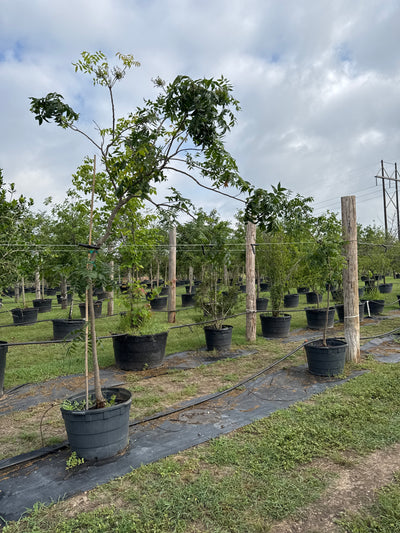


Yucca Thompson's


Yucca Thompson's
🌱 Planting Installation
Thompson's Yucca, also known as Trans-Pecos Yucca, is a striking, trunk-forming arborescent yucca native to the high desert regions of West Texas and northern Mexico. Highly prized as a focal point in xeriscape landscapes, it develops architectural, pom-pom-like heads of powder-blue foliage atop sturdy trunks. The Thompson's Yucca features dense, neat, spherical rosettes of stiff, narrow blue-gray to glaucous blue-green leaves (8–16 inches long). The leaves have yellow finely serrated margins and sharp terminal spines. Unlike some single-trunk yuccas, Thompson Yuccas frequently branch at a lower height or after flowering, forming multi-headed, multi-trunk trees growing 6 to 12 feet tall (and up to 3 to 5 feet wide per head). The upper trunks often retain a protective "skirt" of dry, downward-pointing old leaves. In late spring to early summer, mature heads produce tall, dense flower spikes rising 2 to 4 feet above the foliage, covered in clusters of creamy-white, bell-shaped blossoms. Overall, it is drought-tolerant and remarkably cold-hardy down to (-10°F to -15°F) making it ideal for Rock gardens or xeriscapes.
| Scientific Name | Yucca thompsoniana (Thompson's Yucca / Trans-Pecos Yucca) |
| Foliage: Evergreen |
Leaves: Evergreen; dense, symmetrical spherical heads of stiff, radiating glaucous blue-green leaves perched atop single or branched trunks. Stiff, narrow, linear, 8–16 inches long with a sharp terminal spine and finely tooth-like (denticulate) yellow margins Flowers: Large, dense panicles of showy, bell-shaped, creamy-white nodding blossoms borne on a tall spike (2–4 ft above foliage) in late spring to early summer Fruit: Dry, erect, 3-chambered dehiscent capsule (approx. 1.5–2 inches long). Seeds: Thin, flat, dull-black seeds packaged inside the dry capsule. Bark: Fibrous, dark gray-brown trunk bark; upper trunk is often covered in a dense, protective "skirt" of persistent, dried old leaves. |
| Life Span: Polycarpic | 50–100+ years. It blooms many times over its life and does not die after it flowers. |
| Mature Height | Trunk/Foliage: 6–12 ft tall (occasionally up to 15 ft); In Bloom: 8–15+ ft tall |
| Mature Width (Spread) | 3–5 ft per rosette head (multi-trunk specimens expand wider) |
| Growth Rate | Very Slow (1–3 inches of trunk per year) |
| USDA Zone / Chill Hours | Zones 5b–10b (Cold hardy down to -10°F to -15°F / -23°C to -26°C); No chill hours required. |
PLANT CARE & CHARACTERISTICS
Light Requirements: Full Sun (Requires maximum direct sunlight for tight crown formation and intense blue leaf coloration).
Water Requirements: Low / Xeric; requires minimal to no supplemental water once established.
Drought Resistance: Exceptional / Extremely High
Soil Type: Extremely well-draining, lean soils (limestone gravel, rocky clay, caliche, coarse sand); pH 6.5–8.5; highly susceptible to rot in wet clay.
Deer Resistance: High for foliage (rigid, sharp-spined leaves deter browsing); Moderate/Low for flower stalks (deer may eat emerging tender bloom stalks).
Pest / Disease Resistance: High resistance to cold and heat; susceptible to Yucca Weevil (Scypophorus acupunctatus) and black spot fungal leaf rot if kept overly wet.
Pollination: Obligate mutualism with Yucca Moths (Tegeticula species) for wild fruit/seed production. Obligate mutualism is a biological interaction where two different species depend completely on each other to survive or reproduce. If one species dies out or disappears, the partner species cannot live. It is a strict "ride or die" partnership in nature.
Pruning: Low maintenance; remove spent flower stalks down to the crown in summer. Dried lower leaves can be trimmed for a clean, bare trunk look or left as a natural skirt.
PROPAGATION
Propagating Thompson's Yucca is most commonly done via trunk/head cuttings (which yields a large, established specimen quickly) or seeds (ideal for growing many plants at once, though slow-growing).
Method 1: Trunk / Head Cuttings (Beheading)
Because Yucca Thompson is a trunk-forming species, you can sever a healthy crown or trunk section to start a new plant. This process also encourages the headless mother trunk to branch out into multiple new heads.
1. Make a Clean Cut: Late Spring to Early Summer (active growth). Using a sharp, sanitized handsaw or loppers, cut through the trunk or a side branch at least 6–12 inches below the leaf head. Make a straight, clean cut perpendicular to the trunk.
2. Strip Lower Leaves: Lower 3–4 inches of trunk. Strip away the lowest leaves along the bottom few inches of the cut trunk to expose bare stem tissue where roots will emerge.
3. Callus the Cut Completely: 7 to 14 days in a shaded, warm, dry area.
-
Crucial step: Place the cutting upright or on its side in a dry, shady spot with good airflow. The cut end must form a hard, completely dry callus before planting; moist, fresh wood will rot in soil.
4. Plant in Dry, Gritty Mix: 70/30 pumice or coarse sand to cactus soil. Set the calloused trunk 3–5 inches deep into a pot with an extremely fast-draining, gritty mix. Stake the cutting if necessary to keep it stable.
5. Keep Dry Until Rooted: First 3–4 weeks. Do not water for the first 3 to 4 weeks. Keep the pot in bright, indirect sunlight or light shade. Once fine roots begin to form (usually 4–8 weeks), apply light waterings, allowing the mix to dry out completely between waterings.
Method 2: Growing from Seed
Growing Yucca Thompson from seed requires patience, as seedlings take 3–5 years to develop a recognizable rosette and years more to form a trunk.
1. Scarify & Soak: Lightly rub the hard black seed coat with fine sandpaper or a nail file to weaken the outer layer. Soak the seeds in warm water for 24 hours.
2. Cold Stratify (Recommended): Mix seeds with slightly damp sand or perlite in a sealed bag and place in the refrigerator (35-40°F) for 30 days. This simulates winter and significantly improves germination uniformity.
3. Sow: Place seeds 1/4 inch deep in pots filled with a gritty cactus seed-starting mix (e.g., 50% pumice/perlite, 50% peat/coarse sand).
4. Environment: Keep the soil barely damp (never soggy) at warm temperatures (75-85°F) under bright, filtered light.
5. Germination: Expect seedlings to sprout in 3 to 8 weeks. Once true leaves appear, move the seedlings into individual pots and increase sunlight gradually.
Trunk Cuttings vs. Seed Propagation
| Feature | Trunk / Head Cuttings | Seed Propagation |
| Speed to Mature Size |
Fast (Instantly an established head) | Very Slow (Years to form a trunk) |
| Success Rate | High (~85–90% if well-calloused) | Moderate (~60–75% after stratification) |
| Mother Plant Impact |
Forces mother trunk to branch | No impact on wild/landscape plants |
| Best Use | Reserving/re-rooting fallen trunks or branching a landscape plant | Mass production, genetic diversity |


