


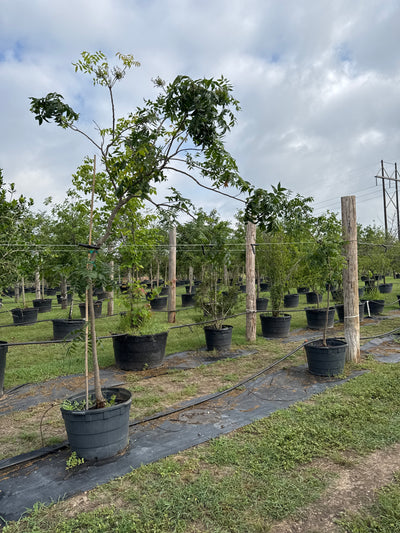


Yucca Soft Leaf

Yucca Soft Leaf
🌱 Planting Installation
Soft-Leaf Yucca, commonly called Curve-Leaf Yucca, is a graceful, architectural evergreen native to the coastal southeastern United States. Yucca Soft Leaf is characterized by its large, sword-shaped leaves that are flexible and have a soft texture compared to some other yucca species. The foliage Grows as a multi-stemmed or single-trunk shrub-like tree reaching 5 to 8 feet tall (and 4 to 6 feet wide). As lower leaves age, they form a protective downward-pointing "skirt" along the trunk or can be trimmed to expose an attractive woody stem. In late spring to mid-summer, mature heads produce massive 3- to 5-foot central panicles packed with fragrant, bell-shaped ivory-white flowers that attract pollinators. It stands out from other yucca varieties because it tolerates high humidity, rainfall, and coastal salt spray. Yucca Soft-Leaf thrives in full sun to partial shade and adaptable to sandy, loamy, or well-draining soils. Unlike its stiff, sharp-spined desert relatives, it is widely favored for lush, non-hazardous foliage that blends naturally into both tropical and xeriscape landscapes and makes it safe for walkways, pool decks, and patios.
| Scientific Name | Yucca recurvifolia (syn. Yucca gloriosa var. recurvifolia) — Soft-leaf Yucca / Curve-leaf Yucca |
| Foliage: Evergreen |
Leaves: Graceful, arching rosettes of soft, non-rigid foliage atop single or multi-stemmed trunks. Pliable, strap-like, 2–3 ft long; dark blue-green to olive-green, distinctly bending and curving downward with smooth margins and a soft, non-hazardous terminal tip. Flowers: Large, bell-shaped, fragrant ivory-white to cream blossoms borne on a tall, dense central panicle (3–5 ft above foliage) in late spring to mid-summer. Fruit: Fleshy, oblong 3-chambered indehiscent capsule (2–3 inches long) Seeds: Flat, thin, dull-black seeds embedded within the fruit Bark: Fibrous, grayish-brown woody trunk bark; upper trunk is often covered by a skirt of persistent dried leaves |
| Life Span: Polycarpic | 30–50+ years. It blooms multiple times over its lifespan and does not die after producing flowers. |
| Mature Height | Trunk/Foliage: 5–8 ft tall (occasionally 10 ft); In Bloom: 8–12 ft tall |
| Mature Width (Spread) | 4–6 ft |
| Growth Rate | Moderate (faster growing than most desert yuccas) |
| USDA Zone / Chill Hours | Zones 7a–10b (Cold hardy down to 0°F / -18°C); No chill hours required |
PLANT CARE & CHARACTERISTICS
Light Requirements: Full Sun to Partial Shade (tolerates light shade and high humidity better than arid desert species).
Water Requirements: Low to Moderate; very adaptable, tolerates coastal moisture and rainfall better than desert yuccas once established
Drought Resistance: High / Exceptional
Soil Type: Adaptable to sandy, loamy, or well-draining clay soils; pH 6.0–8.0; highly tolerant of poor or coastal salt-spray soils.
Deer Resistance: High for foliage (soft leaves are rarely browsed); Moderate for flower stalks (tender emerging bloom spikes may be eaten).
Pest / Disease Resistance: High overall; occasionally susceptible to leaf spot fungal infection in dense shade/high humidity or Yucca Weevil.
Pollination: Obligate mutualism with Yucca Moths (Tegeticula species) for wild seed production. Obligate mutualism is a biological interaction where two different species depend completely on each other to survive or reproduce. If one species dies out or disappears, the partner species cannot live. It is a strict "ride or die" partnership in nature.
Pruning: Low maintenance; cut spent flower stalks down to the crown in late summer. Trim dead bottom leaves to reveal the woody trunk or leave as a natural protective skirt.
PROPAGATION
Propagating Soft-Leaf Yucca is fast and reliable. Because it forms woody trunks and branches freely, you have two primary vegetative options: stem/trunk cuttings and basal offsets (pups). Both methods clone the parent plant exactly and establish much faster than starting from seed.
| Method | Speed to Root | Best Time | Primary Advantage |
| Stem / Trunk Cuttings | 4–8 Weeks | Late Spring to Mid-Summer | Great way to reduce plant height or multiply branched trunks |
| Basal Offsets ("Pups") | 3–6 Weeks | Spring to Early Summer | Already possesses an established root base |
| Rhizome / Root Cuttings | 2–3 Months | Late Winter / Early Spring | Uses underground root chunks dug during transplanting |
Method 1: Stem & Trunk Cuttings (Beheading)
If your Soft-Leaf Yucca has grown too tall, developed leggy branches, or leaned over, you can cut off a section of the leafy trunk to root a brand-new tree.
1. Take the Cutting: Late Spring / Summer during active growth. Using a sharp hand saw or loppers, cut a leafy stem or trunk section 8–18 inches long. Make a clean cut straight across the stem.
2. Strip Lower Leaves: Bottom 4–6 inches of the cut stem. Peel away the lowest leaves to expose a bare section of woody stem. This bare zone is where adventitious roots will emerge.
3. Callus the Cut End (Crucial): 5 to 10 days in a warm, dry, shaded spot. Allow the raw cut to dry completely until a hard, pale callus forms over the exposed wood. Do not skip this step—planting a raw cut directly into damp soil leads to soft rot.
4. Plant in Fast-Draining Medium: Gritty mix: 60% perlite/pumice + 40% potting soil. Insert the calloused end 3–5 inches deep into a pot filled with gritty mix. Stake the trunk if needed so it stays steady.
5. Keep Lightly Moist in Warmth: First 3–4 weeks. Place the pot in bright, indirect sunlight. Water lightly once at planting, then hold off on heavy watering until new growth appears (indicative of root formation).
Method 2: Separating Basal Offsets ("Pups")
Soft-Leaf Yucca routinely sends up clonal shoots from its underground root crown or lower trunk base.
1. Locate & Dig: Clear away soil around the base of the pup to find where its connecting rhizome attaches to the main trunk.
2. Sever Cleanly: Slice through the connecting stem with a sharp trowel or hori-hori knife, keeping as many of the pup's own roots intact as possible.
3. Callus: Let the pup sit in a dry, shady spot for 24 to 48 hours so the cut wound seals.
4. Pot Up: Plant in a container with sharp-draining cactus/succulent soil, water lightly, and keep in warm, filtered light until established.


