


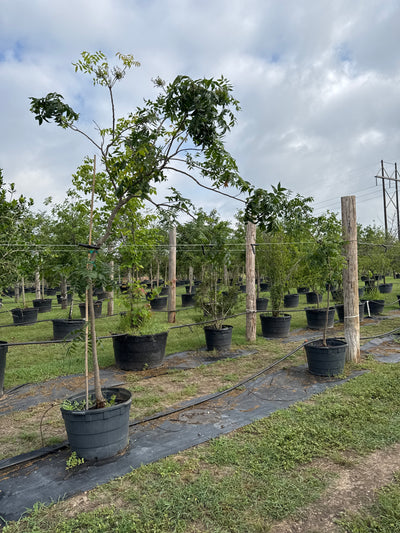


Yucca Color Guard


Yucca Color Guard
🌱 Planting Installation
Yucca 'Color Guard', commonly known as Variegated Adam's Needle, is one of the most vibrant variegated ornamental agaves available. The Yucca Color Guard features sword-like, pliable leaves with a brilliant, wide golden-yellow center strip bordered by deep green margins. It also has fine, curly white filaments (threads) that naturally fray along the leaf edges, adding texture. During cold winter weather, the bright yellow centers flush with striking shades of pink, rose, or coral, providing multi-season visual interest. The Yucca Color Guard forms a compact, stemless rosette reaching 2 to 3 feet tall and 3 to 4 feet wide. In late spring to mid-summer, a tall central spike rises 3 to 6 feet high, bearing large clusters of nodding, fragrant, creamy-white bell-shaped flowers. Overall, the Yucca Color Guard is selected for its year-round bright color, it brings a bold architectural accent to borders, rock gardens, and container plantings.
| Scientific Name | Yucca filamentosa 'Color Guard' (Variegated Adam's Needle Yucca) |
| Foliage: Evergreen |
Leaves: Evergreen; dramatic stemless rosette featuring brilliant broad central golden-yellow stripes bordered by bright green margins. Strap-like, pliable, 1.5–2.5 ft long; soft margins threaded with prominent curling white filaments (threads); foliage flushes pinkish-rose to coral in cold winter weather. Flowers: Large, fragrant, creamy-white, bell-shaped nodding blossoms borne in dense panicles on tall central spikes (3–6 ft tall) in late spring to mid-summer. Fruit: Dry, erect 3-chambered dehiscent capsule (approx. 1.5–2 inches long) Seeds: Flat, thin, dull-black seeds tightly stacked inside the dry capsule Stemless (acaulescent); lacks a trunk or bark, growing from a thick underground woody caudex/rootstock |
| Life Span: Monocarpic | 20–50+ years (individual flowering rosettes die back after blooming but continuously offset at the base) |
| Mature Height | Foliage: 2–3 ft tall; In Bloom: 3–6 ft tall (with flower spike) |
| Mature Width (Spread) | 3–4 ft |
| Growth Rate | Slow to Moderate |
| USDA Zone / Chill Hours | Zones 4a–10b (Cold hardy down to -20°F to -30°F / -29°C to -34°C); No chill hours required |
PLANT CARE & CHARACTERISTICS
Light Requirements: Full Sun to Partial Shade (Full sun produces the brightest gold leaf coloration; tolerates light shade).
Water Requirements: Low; highly water-wise once established (prefers drying out between waterings).
Drought Resistance: High / Exceptional
Soil Type: Adaptable to sandy, gravelly, dry loam, or poor clay soils provided drainage is good; pH 5.5–8.5.
Deer Resistance: High for foliage (fibrous leaves are avoided); Moderate for flower stalks (deer occasionally browse emerging bloom spikes).
Pest / Disease Resistance: High resistance to cold, heat, drought, and pests; susceptible to fungal leaf spot in poorly ventilated, overly wet shade.
Pollination: Obligate mutualism with Yucca Moths (Tegeticula species) for wild seed production. Obligate mutualism is a biological interaction where two different species depend completely on each other to survive or reproduce. If one species dies out or disappears, the partner species cannot live. It is a strict "ride or die" partnership in nature.
Pruning: Low maintenance; cut spent flower stalks down to the base in late summer. Remove dead or damaged lower leaves as needed.
PROPAGATION
Propagating Yucca 'Color Guard' is fast and reliable. Because it is a variegated cultivar, vegetative propagation using basal offsets (pups) or root/rhizome cuttings is required to guarantee that the new plants inherit the brilliant yellow-and-green variegated foliage.
Method 1: Basal Offset Division (Recommended)
As the central flowering rosette matures and finishes its bloom cycle, it produces offshoots (pups) around its underground crown.
1. Expose the Connecting Rhizome: Spring or early summer during active root growth. Gently scrape away the soil around a pup at the base of the main plant to locate where its underground runner attaches to the main crown.
2. Sever the Offshoot: Sharp trowel, hori-hori knife, or clean shears. Cut straight through the connecting rhizome, keeping as many of the pup's own roots intact as possible.
3. Callus the Cut Wound: 24 to 48 hours in a shaded, ventilated space. Allow the severed end to dry in a shady spot until a hard callus forms over the wound. Planting a fresh cut into damp soil invites fungal root rot.
4. Pot Up in Well-Draining Mix: Gritty mix: 50% pumice/perlite + 50% cactus potting soil. Plant the calloused pup into a container filled with fast-draining soil. Place in bright, indirect light or full morning sun.
5. Water Sparingly: First 2–3 weeks. Water lightly once at planting, then let the soil dry out significantly between waterings. Roots anchor in 3 to 6 weeks.
Method 2: Root & Rhizome Cuttings
If you are digging up, moving, or dividing a mature Yucca 'Color Guard', you can take advantage of its thick, fleshy underground rhizomes to produce multiple new clones.
1. Harvest Roots: Dig down near the base of a mature specimen and sever thick, fleshy rhizome sections (at least finger-thickness) into 2 to 4-inch pieces.
2. Callus: Let the root pieces dry in a shaded, airy location for 2 to 3 days until the cut ends dry out completely.
3. Plant Horizontally: Lay the root cuttings horizontally on a bed of gritty cactus mix (or a 50/50 perlite and peat mix) in shallow pots or flats.
4. Cover: Lightly cover the root sections with 1/2 inch of gritty soil mix.
5. Care: Place in a warm spot (70-80°F) in bright, indirect light. Keep the medium slightly damp (never waterlogged).
6. Sprouting: Within 6 to 10 weeks, dormant buds along the rhizome will sprout small variegated rosettes above the soil line and send down fresh roots.
Propagation Summary
| Method | Speed to Established Plant |
Best Season | Key Advantage |
| Basal Offsets ("Pups") | Fast (3–6 months) |
Spring to Early Summer | Already has an established rosette shape and roots |
| Root/ Rhizome Cuttings | Moderate (4–8 months) |
Late Winter to Early Spring | Produces multiple new plants from a single parent root system |


