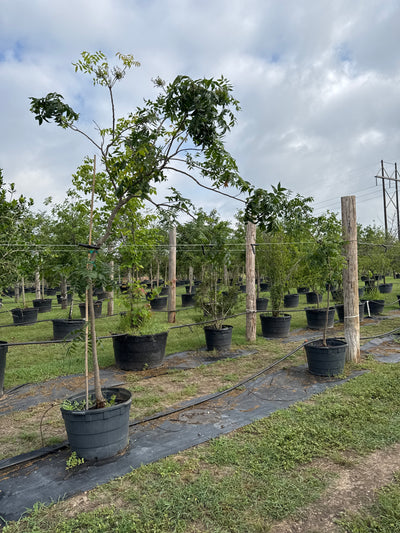
LSU Purple Fig is a highly reliable, heavy-bearing deciduous fruit tree renowned for its remarkable disease resistance, early production, and sweet fruit. Released by the Louisiana State University Agricultural Experiment Station in 1991, this fast-growing tree features a broad, multi-stemmed growth habit with dense branching and large, dark green leaves that have three to five deeply cut lobes. As a common fig type, its unique inverted flowers are contained entirely within the developing fruit cavities, requiring no insect pollination. The small-to-medium-sized figs feature a smooth, glossy skin that turns a deep violet-purple to dark magenta as they ripen, enclosing a soft, strawberry-pink to amber flesh with tiny, soft seeds and a rich, mild honey flavor.
In edible landscapes and home orchards, LSU Purple Fig typically matures to a manageable eight to twelve feet in height and spread when planted in the ground, though it can easily be kept smaller with routine pruning or grown in large containers at four to six feet. It is one of the earliest fig varieties to begin bearing fruit, often producing a small breba crop on previous year's wood in early summer followed by a heavy main crop from late July straight through the first autumn freeze. Its dense canopy, attractive leaves, and smooth silver-gray bark make it an appealing ornamental centerpiece for backyards, sunny patios, or edible privacy borders.
| Scientific Name |
Ficus carica 'LSU Purple' |
| Foliage: Deciduous |
Deciduous fruit tree / multi-stemmed shrub; dense, broad, spreading canopy.
Leaves: Large, 3- to 5-lobed leaves (5–10 inches long); thick, rough-textured dark green surface with paler undersides; prominent pale veins
Flowers: Inverted internal flowers (syconia); invisible from the outside, lining the inner cavity of the developing fruit
Fruit: Medium-sized, glossy dark purple-to-black skin with a closed eye; soft, dark reddish-pink to amber flesh; sweet, mild honey flavor
Seeds: Tiny, soft, edible achenes inside the flesh; soft crunch without grit
Bark: Smooth, silver-gray bark on main trunks and mature branches; younger stems are green to light brown; yields milky white latex sap when cut
|
| Life Span: Perennial |
35–50+ years |
| Mature Height |
In-Ground: 8–12 ft (up to 15 ft if unpruned); Container: 4–6 ft |
| Mature Width (Spread) |
8–12 ft |
| Growth Rate |
Fast (3–4 ft per year when young) |
| USDA Zone / Chill Hours |
Zones 7a–10b (Cold-hardy down to 0°F to 10°F / -18°C to -12°C); Low chill requirement (~100–300 chill hours) |
PLANT CARE & CHARACTERITSICS
Light Requirements: Full Sun (Requires 6–8+ hours of direct sunlight daily for high sugar development and dark skin color).
Water Requirements: Moderate; prefers consistent moisture while fruiting, but requires good drainage.
Drought Resistance: High once established (Drought-stressed trees may drop fruit prematurely).
Soil Type: Highly adaptable; prefers fertile, organic, well-draining loam or sandy clay; pH 6.0–7.5; intolerant of soggy roots.
Deer Resistance: High (Milky latex sap in stems and leaves makes it unpalatable to deer and rabbits).
Pest / Disease Resistance: Exceptional resistance to Fig Rust, Foliage Blight, and Root-Knot Nematodes (bred by LSU specifically for disease resistance in warm, humid climates).
Pollination: Self-fertile (Common fig type; sets heavy fruit crops without wasp pollination).
Harvest: Produces a small early summer breba crop on old wood, followed by a heavy main crop from late July through autumn.
Yield: Heavy. Reliable production starting at a young age (often bears fruit in its 1st or 2nd year)
Storage / Shelf Life: Fresh figs are delicate; store refrigerated for 3–5 days; ideal for drying, freezing, or preserves.
Pruning: Prune during late winter dormancy to remove deadwood, crossing branches, or suckers. Can be trained as a central leader or multi-stemmed bush.