


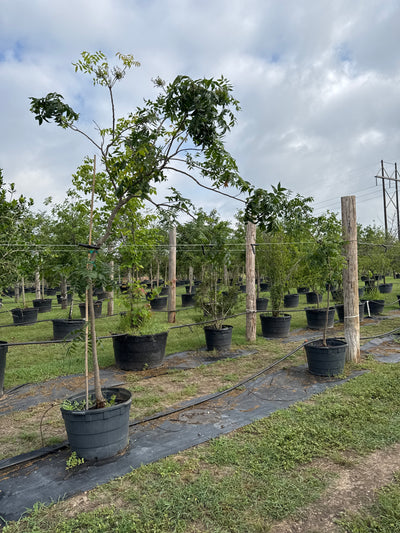


Yucca Twist Leaf Green


Yucca Twist Leaf Green
🌱 Planting Installation
The Green Twist-Leaf Yucca is the standard wild-type form of this central Texas native evergreen. Valued for its soft, architectural form and low-growing footprint, it provides clean visual structure to dry, sun-drenched landscapes without the hazardous, rigid spines typical of larger yuccas. The Green Twist-Leaf Yucca features vibrant medium-to-olive green leaves that naturally twist and wave as they reach maturity. The foliage is pliant and flexible, outlined with fine yellow-to-reddish margins that offer subtle color accenting up close. It grows into a neat, compact rosette staying close to the ground at 1 to 2 feet tall and 2 to 3 feet wide. Over time, it slowly produces basal offsets (pups) to form small clumps. In late spring or early summer, it sends up a tall, 4- to 6-foot central flower stalk loaded with large, creamy-white, bell-shaped blossoms that attract native pollinators. It is highly drought tolerant and can survive on virtually no supplemental water once established. Overall, the Green Twist-Leaf Yucca is an ideal plant for tight spaces, rock gardens, border foregrounds, xeriscape, or container planting.
| Scientific Name | Yucca rupicola (Twist-leaf Yucca / Texas Yucca) (Standard green-foliage wild form) |
| Foliage: Evergreen |
Leaves: Evergreen; low, stemless rosettes of soft, flexible leaves that distinctly twist and spiral as they mature. Narrowly lanceolate, 12–24 inches long; bright medium-green to dark olive-green with fine, yellowish, orange, or reddish finely serrated (denticulate) margins. Flowers: Large, bell-shaped, white to pale greenish-white nodding flowers on a tall central flowering stalk (4–6 ft tall) in late spring to early summer Fruit: Dry, 3-chambered dehiscent capsule (approx. 2 inches long) Seeds: Small, flat, dull-black seeds enclosed within the dry pod Trunkless (acaulescent): Lacks a true trunk or bark, growing from a branched underground caudex/rootstock |
| Life Span: Monocarpic | 20–50+ years (monocarpic rosettes die after flowering but continuously offset and clone at the base) |
| Mature Height | Foliage: 1–2 ft tall; In Bloom: 4–6 ft tall (with flower spike) |
| Mature Width (Spread) | 2–3 ft per rosette (clumps expand wider over time as basal pups form) |
| Growth Rate | Slow |
| USDA Zone/Chill Hours |
Zone 6a–10b (Cold hardy down to 0°F / -18°C); No chill hours required |
PLANT CARE & CHARACTERISTICS
Light Requirements: Full Sun to Partial Shade (Tolerates light shade better than blue forms, though full sun promotes best blooming).
Water Requirements: Low; highly water-wise once established (minimal to no supplemental irrigation needed).
Drought Resistance: High / Exceptional
Soil Type: Lean, sharply draining soils (limestone, caliche, gravelly clay, sandy loam); pH 6.0–8.2; susceptible to rot in waterlogged soils.
Deer Resistance: High for foliage (pliant, sharp-tipped leaves are avoided); Low for flower stalks (deer frequently eat emerging flower stalks)
Pest/Disease Resistance: High resistance to drought and disease; occasionally susceptible to Yucca Weevil or root rot if drainage is poor.
Pollination: Obligate mutualism with Yucca Moths (Tegeticula species) for wild pollination. Obligate mutualism is a biological interaction where two different species depend completely on each other to survive or reproduce. If one species dies out or disappears, the partner species cannot live. It is a strict "ride or die" partnership in nature.
Pruning: Low maintenance; cut spent bloom stalks to the base in late summer, and trim dead or yellowed bottom leaves as needed.
PROPAGATION
Propagating Green Twist-Leaf Yucca is straightforward because it naturally forms clones around its base. While it can be grown from seed, vegetative methods like offset division and rhizome cuttings give you established plants much faster.
Method 1: Division of Basal Offsets (Pups)
As the main rosette matures and flowers, it produces lateral offspring (pups) attached to the parent plant's underground caudex.
1.Expose the Connecting Rhizome: Late Spring to Early Summer. Gently scrape away the soil around the base of a young rosette until you locate where its underground stem attaches to the parent plant.
2. Sever the Offshoot: Sharp, sanitized hand pruners or hori-hori knife. Cut the connecting rhizome cleanly, keeping as many of the pup's own roots intact as possible.
3. Callus the Cut Wound: 24–48 hours in a shaded, dry spot. Allow the severed end to dry and form a protective callus. Planting a fresh, open wound directly into damp soil invites fungal rot.
4. Plant in Well-Draining Soil: 50/50 mix of coarse sand/pumice and potting soil. Set the calloused pup into a pot or garden bed with gritty, fast-draining soil. Water lightly once, then hold off on watering until root growth begins (about 2–3 weeks).
Method 2: Rhizome / Root Cuttings
If you are transplanting or digging up an existing plant, you can use pieces of its thick underground fleshy roots.
1. Harvest Roots: Cut 2- to 4-inch sections of thick rhizome (at least thumb-thickness) from the base.
2. Callus: Let the cuttings dry in a cool, shady spot for 2–3 days.
3. Plant Horizontally: Lay the root sections horizontally on a bed of damp sand/perlite and cover with 1/2 inch of gritty soil.
4. Care: Keep lightly moist in indirect light at 70°F+. New rosettes will sprout from dormant buds along the rhizome in 6 to 8 weeks.
Method 3: Growing from Seed
Growing Yucca Twist Leaf Green from seed requires patience and cold stratification.
1. Seed Prep: Nick or lightly sand the hard seed coat, then soak in warm water for 24 hours.
2. Stratification: Store seeds in damp sand inside a sealed bag in the refrigerator (35–40°F) for 30 days to break dormancy.
3. Germination: Sow 1/4 inch deep in gritty cactus mix at 70–80° F. Seeds germinate in 3 to 8 weeks.
Propagation Summary
| Method | Time to Established Plant | Best Season |
| Basal Offsets ("Pups") | 2–3 months | Late Spring / Early Summer |
| Rhizome / Root Cuttings | 4–6 months | Early Spring (Dormancy end) |
| Seeds | 1–2 years | Spring |


