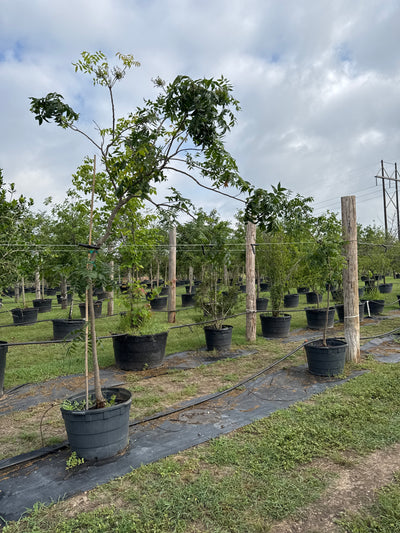
Ozark Elderberry is a heavy-producing, fast-growing deciduous shrub native to eastern North America, celebrated for its large berry clusters and rich native heritage. Rising on upright, arching stems with soft pithy centers and light gray-brown bark, this multi-stemmed perennial features large, pinnately compound leaves with coarsely serrated, medium-green leaflets. In early summer, the bush produces broad, flat-topped clusters of creamy-white, fragrant flowers that fill the air with a light honey scent while drawing in honeybees and butterflies. By late summer, these floral cymes transform into heavy, drooping umbrella-like clusters of small, glossy purple-black berries packed with juice, antioxidants, and dark pigments.
In edible landscapes, wildlife gardens, and fruit orchards, Ozark Elderberry reaches a mature height of eight to twelve feet with a spread of six to ten feet. Because it naturally spreads by underground root suckers, it quickly forms a dense, privacy-providing thicket or fruiting hedge if allowed to naturalize along fence lines, stream banks, or pasture edges. Beyond its high agricultural value for making jams, jellies, wines, and immune-boosting elderberry syrups, it serves as a critical habitat and late-summer food source for songbirds and wild pollinators.
| Scientific Name |
Sambucus canadensis 'Ozark' (syn. Sambucus nigra subsp. canadensis 'Ozark') |
| Foliage: Deciduous |
Deciduous multi-stemmed fruiting shrub; upright, arching, clump-forming habit.
Leaves: Pinnately compound, 5–11 inches long with 5–9 elliptic-to-lanceolate leaflets; medium to dark green with fine serrated margins; turns yellow in autumn.
Flowers: Large, broad, flat-topped clusters (cumbs/cymes) of small, fragrant, 5-petaled cream-white blossoms appearing in early summer
Fruit: Large, heavy clusters of small, glossy, deep purple-to-black berries; juicy and rich in antioxidants; raw berries are mildly toxic and should be cooked before consuming.
Seeds: Tiny, hard nutlets contained inside each small berry.
Bark: Light brownish-gray with prominent raised lenticels (corky dots); soft, pithy white center inside stems; smooth when young, slightly furrowed with age.
|
| Life Span: Perennial |
20–30+ years |
| Mature Height |
8–12 ft |
| Mature Width (Spread) |
6–10 ft (Spreads via underground root suckers to form thickets if unmanaged) |
| Growth Rate |
Fast (3–5 ft per year when young) |
| USDA Zone / Chill Hours |
Zones 4a–9b (Cold-hardy down to -25°F to -30°F / -31°C to -34°C); Requires ~300–500 winter chill hours |
PLANT CARE & CHARACTERISTICS
Light Requirements: Full Sun to Partial Shade (Full sun yields maximum flower production and heavy fruit sets).
Water Requirements: Moderate to High; prefers moist to wet soil; needs regular watering during fruit set.
Drought Resistance: Low to Moderate (Suffers under prolonged drought; prefers damp, lowland, or stream-side conditions).
Soil Type: Highly adaptable; thrives in moist, rich, organic loam, clay, or alluvial soils; pH 5.5–7.5; tolerates poor drainage better than most fruit plants.
Deer Resistance: Moderate (Deer generally avoid mature stems, but may browse tender new spring growth).
Pest / Disease Resistance: High natural resistance to pests and diseases; susceptible to elderberry rust, leaf spot, cane borers, and bird feeding during harvest.
Pollination: Partially self-fertile, but yield and berry size increase significantly when cross-pollinated with another Sambucus canadensis variety (e.g., 'Wyldewood', 'Bob Gordon', or 'Ranch')
Harvest: Late summer (August to September); harvest entire berry clusters when all fruit turns uniform glossy purple-black.
Yield: Heavy. Mature bushes produce 12–20+ lbs of fruit annually.
Storage / Shelf Life: Fresh berries are highly perishable (1–2 days refrigerated); best processed immediately into syrups, jams, wines, or frozen/dehydrated.
Pruning: Prune during late winter dormancy. Cut back 3-year-old or older canes down to the ground, as 1- and 2-year-old canes produce the highest quality fruit. Remove weak, damaged stems or unwanted root suckers to control spreading.