


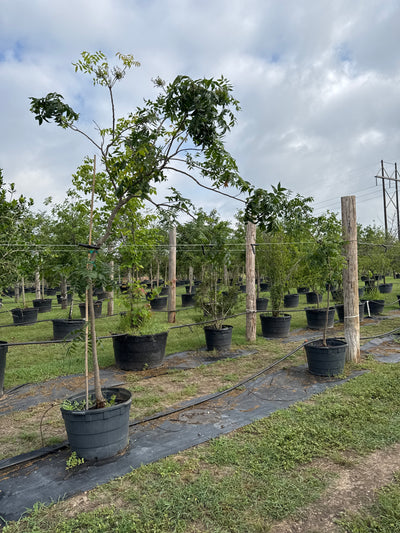

1 Gallon Cedar Elm


1 Gallon Cedar Elm
🌱 Planting Installation
The Cedar Elm is a tough, adaptable, medium-to-large deciduous shade tree native to Texas and northeastern Mexico. Known for being "tough-as-nails" for its exceptional drought tolerance and ability to thrive in a wide variety of harsh environments, from rocky limestone ridges to heavy clay soils. Cedar Elms produce stiff, dark green leaves that are notably rough to the touch—feeling like fine sandpaper on top. The leaves turn bright golden-yellow in late autumn and later drop in the winter revealing flat, corky ridges or "wings" along the branches and bark. Cedar Elms typically grow 50 to 70 feet tall with a 40- to 60-foot spread. They feature an upright, rounded canopy that provides dense, excellent shade. Unlike most spring-blooming elms, it is a late-summer to autumn bloomer. It relies on the wind to disperse its tiny flowers and papery, winged seeds (samaras). Also when summer is ending, Cedar Elms are known to dump immense amounts of lightweight pollen and are considered a major seasonal allergen across the Southern United States.
| Scientific Name | Ulmus crassifolia |
|
Foliage: Deciduous |
Leaves: Small, dark green, and have rough, sandpaper-like texture. The leaves turn a golden-yellow color in the autumn (usually November), providing a nice late-season splash of color. In the winter, the leaves drop leaving a bare canopy of beautifully textured, scaly, and corky bark. Flowers: Unlike most other elms that bloom in the spring, the Cedar Elm blooms in late summer or fall (August–September). The flowers are tiny, inconspicuous, and lack petals. They hang in small, reddish-green clusters (cymes) from the leaf axils. Because they are wind-pollinated, they don't need showy petals to attract insects, often going completely unnoticed unless you look closely. Seeds (Samaras): The seed is a small, flat, oval disc known as a samara (about 1/3 to 1/2 inch long). The central seed pocket is completely surrounded by a thin, papery wing covered in fine hairs. These light, winged structures are deeply notched at the tip and are perfectly adapted to be carried away by the autumn wind. Bark: Young branches and twigs often develop heavy, flat, corky ridges or "wings" running along the sides. As the tree ages, the main trunk bark becomes a light brownish-gray to dark gray. It breaks into brittle, flattened ridges and develops loose, scaly flakes that break away, giving it a deeply furrowed, deeply textured appearance. |
| Lifespan: Perennial | The average lifespan of a Cedar Elm typically ranges from 80-100 years in urban landscapes or under standard backyard conditions. However, in ideal, undisturbed natural habitats—such as well-drained river bottoms or limestone slopes where it can stretch its roots without soil compaction—a healthy Cedar Elm can easily live for 150 to 175 years. |
| 1 gallon Cedar Elm Height | Average height is 1.5 to 3 feet tall (measured from the top of the soil). |
| 1 gallon Cedar Elm Width (Spread) | 6 to 12 inches |
| Mature Height | 50-70 feet |
| Mature Width (Spread) | 40-60 feet |
| Growth Rate | Moderate (typically 1.5-2.5 feet per year) |
| USDA Zone | Zone 6-9 |
PLANT CARE & CHARACTERISTICS
Light Requirements: Full Sun. Cedar Elms typically perform best with at least 6 hours of direct sunlight but can tolerate partial shade.
Water Requirements: Low to Moderate. While mature Cedar Elms are famously drought-tolerant, a 1-gallon sapling is highly vulnerable to drying out until its roots anchor deep into the surrounding soil.
- The Routine: Water deeply 2 to 3 times a week during its first spring and summer. If temperatures soar above 95°F, check the soil daily and water whenever the top 2 inches feel dry.
- How to Water: Use a slow trickle from a hose at the base of the tree for 10 minutes, or use a 5-gallon bucket with a small hole drilled in the bottom. This slow, deep soaking encourages roots to grow downward rather than staying shallow.
- Year Two and Beyond: Once established, you can back off to watering only during extended dry spells.
Drought Resistance: High. Cedar Elms are one of the most drought-tolerant elms available. They can withstand intense heat and dry soil better than most other shade trees. Although mature Cedar Elms are famously drought-tolerant, a 1-gallon sapling is highly vulnerable to drying out until its roots anchor deep into the surrounding soil.
Soil Type: Highly Adaptable. Cedar Elms are famously tough, thriving in heavy clay, limestone, rocky, or sandy soils, though they prefer good drainage.
-
Mulch: Apply a 2- to 3-inch layer of hardwood mulch in a 3-foot circle around the base of the tree. This keeps the soil moist, regulates root temperature, and keeps weeds at bay.
- ⚠️The "Mulch Volcano" Warning: Keep the mulch 2 inches away from the actual wooden bark of the trunk. Piling mulch against the trunk traps moisture and causes the bark to rot.
- Location: Remember that a 1 gallon Cedar Elm will eventually become a massive shade tree. Plant it at least 15 to 20 feet away from foundations, sidewalks, power lines, and patios.
Deer Resistance: When Cedar Elms are newly planted trees, deer may snack on the tender young shoots. However, mature trees are usually safe.
Pest/Disease Resistance: Cedar elms are susceptible to Dutch Elm Disease, a fungal disease spread by elm bark beetles. They are also prone to insect damage from aphids, spider-mites, cotton scale, and elm leaf beetles. This tree is a frequent host for Mistletoe. While a little mistletoe is harmless, a heavy infestation can stress the tree during droughts. It is best to prune mistletoe out when you see it to keep the tree's energy focused on its own growth.
POLLINATION
While the vast majority of native elms and other shade trees bloom and pollinate in the early spring (January to April), the Cedar Elm is a fall-pollinating tree. Pollination generally occurs from late August through October.
1. The "Pollen Bomb" Phenomenon: Individual Cedar Elms are highly efficient. An individual tree will typically release its entire, massive load of pollen over an intense, concentrated window lasting just 2 to 3 days. However, because different trees across a region mature at slightly different times, the overall regional pollination season stretches for several weeks.
2. The Pollination Mechanism: Cedar Elms are entirely anemophilous, meaning they rely strictly on the wind to transfer pollen from one tree to another.
- No Need for Showy Flowers: Because they do not need to lure insects, birds, or bees, the flowers completely lack petals. Instead, the tree puts all its energy into creating tiny, exposed, reddish-green clusters of stamens and pistils that dangle openly from the branches, perfectly positioned to catch a breeze.
- Pollen Characteristics: To travel effectively via air currents, Cedar Elm pollen grains are incredibly small (roughly 16 to 50 micrometers), dry, and lightweight. This allows them to stay airborne and travel for miles.
⚠️IMPACT ON ALLERGIES: The "Second Elm Season"⚠️
Because it dumps immense amounts of lightweight pollen right as summer is ending, the Cedar Elm is considered a major seasonal allergen across the Southern United States (particularly in Texas and Oklahoma). Cedar Elm pollination perfectly overlaps with the peak of Ragweed season. People who suffer from late-summer and autumn allergies are frequently reacting to a combination of both weed pollen (Ragweed) and tree pollen (Cedar Elm), causing severe hay fever symptoms well outside the traditional spring allergy window.
HOW TO PLANT YOUR 1 GALLON CEDAR ELM
1. Dig the Right Shape (Wide, Not Deep): The single biggest mistake people make is digging a deep, narrow hole like an ice cream cone. Tree roots need to grow outward horizontally to anchor the tree, not straight down.
- The Width: Dig the hole 2 to 3 times wider than the 1-gallon pot. For a standard 1-gallon container (which is roughly 6 to 7 inches wide), your hole should be 14 to 21 inches broad. This loosens the surrounding soil, making it effortless for new, tender roots to push through.
- The Depth: Dig the hole exactly the same depth as the soil inside the pot (usually about 7 inches). You want the bottom of the hole to be firm, undisturbed dirt so the tree doesn’t settle downward after you water it.
2. Find the "Root Flare": Before the tree goes into the ground, look closely at the base of the stem. Find the root flare- the spot where the trunk begins to widen out and transition into the main roots.
- Many nurseries accidentally bury this flare under a layer of extra dirt in the pot.
- Gently scrape away any loose soil on top of the pot until you see that flare exposed. This flare must sit slightly above the surrounding ground level when planted. Planting a tree too deep suffocates the roots and rots the bark.
3. Prepping and Placing the Sapling
- STEP 1: Slide the tree out- Avoid pulling the trunk. Never yank a 1-gallon tree out of its pot by its stem. Instead, lay the pot on its side, squeeze the plastic walls to loosen the root ball, and gently slide the container off the roots.
- STEP 2: Loosen the root ball- Check for circling roots. If the roots are tightly bound or circling the inside of the plastic pot, gently tease them apart with your fingers or make 3 to 4 shallow vertical scores down the sides with a clean knife. This signals the roots to grow outward into the native soil.
- STEP 3: Set the tree in place- Double-check the height. Lower the root ball into the center of your wide hole. Lay a straight tool (like your shovel handle) flat across the ground over the hole. The root flare should sit 1 inch higher than the surrounding soil level to allow for natural settling.
4. Backfilling without Additives: Fill the hole using only the native soil you just dug out.
- Skip the Amendments: Do not mix in potting soil, peat moss, or fertilizers. If you make the hole a luxurious "oasis" of rich potting soil, the roots will happily stay curled inside the hole instead of venturing out into your yard's tough native clay or rock. You want them to get used to your yard's actual soil immediately.
- Tamp Gently: Fill the hole halfway, then gently press the soil down with your hands (not your boots—heavy stomping compacts the dirt and crushes fragile roots). Fill the rest of the way.
5. The Water and Mulch Finish
- The First Soak: Once the hole is filled, run a hose on a slow trickle directly over the root ball for 10 to 15 minutes. This heavily saturates the ground and collapses any hidden air pockets around the roots that could cause them to dry out and die.
- Mulch: Spread a 2- to 3-inch layer of organic mulch over the entire widened area you dug up. Shape the mulch like a donut—flat on top, keeping it 2 inches completely away from the wooden bark of the trunk to prevent rot and pest access.
PRUNING
The absolute best time to prune a Cedar Elm is during late dormancy (January to February), right before new spring growth emerges.
Why Dormancy Matters: Pruning during winter makes the tree's architecture completely visible since the leaves are gone, allowing you to see structural flaws easily. It also ensures the tree heals rapidly when it wakes up in spring. Avoid pruning Cedar Elms between May and October. Fresh cuts during the warm months release sap that can attract the native elm bark beetle, which is a known vector for Dutch Elm Disease (DED). Limiting heavy pruning to late winter significantly lowers this risk.
Step-by-Step Pruning Strategy
Always remove any branches that are Dead, Damaged, or Diseased first. Cut them back to healthy wood or flush with the branch collar.
- ⚠️ 1 gallon Cedar Elms: Do not prune for the first year or two. Let the young tree grow as many leaves as possible to generate energy. Only prune to remove dead or broken twigs.
2. Establish a Central Leader (Structural Focuts): Cedar Elms often try to grow multiple competing main trunks, which creates weak joints. Select the strongest, straightest upright branch to be the single central leader, and shorten or remove competing upright branches.
3. Eliminate Crossing and Rubbing Branches (Canopy Thinning): Because Cedar Elms produce dense twigs, branches frequently cross and rub against each other. Remove the weaker or poorly angled branch of the pair. Rubbing bark creates open wounds that invite pests and fungal diseases.
4. Correct Narrow Crotch Angles (Storm Prevention): Look for branches forming a sharp "V" shape with the main trunk. These narrow angles often trap bark inside the joint (included bark), making them prone to splitting under high winds or ice. Aim for branches with wide, strong "U" shaped angles (45 to 60 degrees).
5. Raise the Canopy (Clearance): Slowly remove the lowest branches over several years if you need clearance for sidewalks, mowing, or structures. Avoid stripping too many low branches at once, as they help build trunk taper and strength.
Pro-Tips for Cedar Elm Care
1. The 25% Rule: Never remove more than 20–25% of the live canopy in a single year. Over-pruning stresses the tree and triggers a massive flush of "water sprouts" (weak, vertical, unsightly twigs that shoot straight up from branches).
2. Identify the Branch Collar: When removing a branch entirely, do not make a flush cut flat against the trunk. Leave the branch collar—the swollen wrinkled ring of bark where the branch meets the trunk. Cutting into this collar damages the tree’s natural sealing mechanism.
3. To Paint or Not to Paint? Generally, modern arboriculture recommends against using pruning paint or wound dressings because they can trap moisture and fungal spores inside. However, if you must make an emergency cut during the summer (e.g., after storm damage), applying a thin layer of specialized pruning seal to the fresh wound can help keep bark beetles away.
PRUNING SUMMARY
| Aspect | Guideline | Why It Matters |
| Best Season | Late Winter (Jan - Feb) | The tree is dormant and leafless, making structural flaws easy to see. It maximizes spring healing. |
| Season to Avoid | Late Spring to Fall (May - Oct) | Fresh summer cuts attract elm bark beetles, which can transmit Dutch Elm Disease (DED). |
| Max Canopy Removal | 20% to 25% in a single year | Over-pruning stresses the tree and triggers a massive flush of weak, vertical "water sprouts." |
| First Priority | The "3 Ds": Dead, Damaged, Diseased | Removing these stops the spread of decay and clears the way to see the tree's true structure. |
| Structural Goal | Establish a Single Central Leader | Prevents the tree from splitting into weak, competing co-dominant trunks. |
| Branch Angles | Favor wide "U" shapes; remove sharp "V" shapes | Narrow "V" joints trap bark inside the seam, making them highly prone to splitting in high winds or ice storms. |
| Density Control | Thin out crossing or rubbing branches | Friction rubs away protective bark, creating open wounds that invite pests and fungi. |
| Cut Technique | Cut just outside the branch collar (the swollen ring at the base) | Do not make flush cuts flat to the trunk; the collar contains the cells needed to naturally seal the wound. |
| Wound Dressings | Skip paint in winter; Use paint for emergency summer cuts | Dressings usually trap moisture, but a temporary sealant on emergency summer cuts blocks beetles from smelling the sap. |