


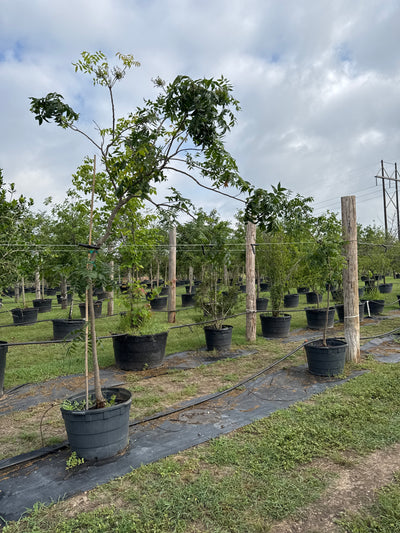

Wisteria Texas


Wisteria Texas
🌱 Planting Installation
The Texas Wisteria, also known as American Wisteria, is a beautiful, woody deciduous vine native to the moist woodlands and riverbanks of the southeastern United States, including East Texas. It is widely celebrated as a gentle, ecologically friendly alternative to highly invasive Asian wisteria species. The foliage features leaves that are dark green and pinnately compound, giving the vine a soft, fern-like texture throughout the summer before turning a gentle yellow in the autumn. In late spring, it produces dense, compact, pinecone-shaped clusters (4 to 6 inches long) of highly fragrant, pea-like flowers in shades of lilac, lavender, and purple. Because it blooms after its foliage has fully emerged, the purple clusters pop beautifully against a lush green backdrop. It is a twinic, climbing vine that reaches a manageable 15 to 30 feet at maturity. Unlike its aggressive counterparts, it grows at a moderate pace, making it easy to control and perfectly suited for home arbors, fences, and pergolas without the risk of crushing its support structure. Texas Wisteria is incredibly hardy (USDA Zones 5–9), pest-resistant, and highly deer-resistant. It prefers moist, rich soils and full sun, and because it blooms exclusively on new growth, it is exceptionally easy and forgiving to prune. In short, it delivers all the romance, fragrance, and cascading beauty of classic wisteria, but with a well-behaved, low-maintenance attitude that won't take over your garden.
| Scientific Name | Wisteria frutescens |
|
Foliage: Deciduous |
Leaves: Deciduous, alternate, and pinnately compound. Each leaf is dark green and composed of 9 to 15 smooth-edged, ovate-oblong leaflets. They emerge late in spring and turn a clear, soft yellow in autumn. Flowers: Dense, compact, pinecone-shaped clusters (racemes) about 4 to 6 inches long. Flowers are pea-like, highly fragrant, and typically a vivid lilac, lavender-blue, or purple. Unlike Asian varieties, it blooms after the leaves have fully emerged, usually starting in late spring with sporadic reblooms throughout summer. Fruit: Elongated, bean-like legume pods that are smooth and completely hairless (unlike the velvety pods of Asian wisterias). They transition from green to a rich, dark brown as they mature in late summer. Seeds: Several smooth, rounded, dark brown to blackish seeds are nestled inside each pod. Bark: On young vines, the bark is smooth and greenish-brown. As the vine matures, it develops a heavy, woody, twisted trunk with rough, fissured, gray-brown bark. |
| Life Span: Perennial | Can easily live for 50 to 100+ years with a stable support system. |
| Mature Height | 15 to 30 feet (highly dependent on the structure it is climbing; can be kept shorter as a free-standing bush with pruning). |
| Mature Width (Spread) | 4 to 8 feet lateral spread along a fence or arbor. |
| Growth Rate | Moderate. It is fast enough to cover an arbor within a few seasons but lacks the destructive, runaway growth rate of Chinese or Japanese species. |
| USDA Zone/Chill Hours | Zone 5 through 9; Requires 200 to 300 chill hours below 45°F (7°C). Because it blooms exclusively on new growth in late spring, it easily satisfies its dormancy requirements even in warm-winter southern climates without risk of frost ruining early flower buds. |
PLANT CARE & CHARACTERISTICS
Light Requirements: Full Sun to Partial Shade. While it grows and survives in partial shade, Full Sun (6+ hours of direct sunlight) is highly recommended to maximize flower production and density.
Water Requirements: Moderate. It prefers consistently moist, well-draining soil, especially during its first two growing seasons to establish its root system. Once established, it can get by on regular natural rainfall.
Drought Resistance: Moderate. Because it is native to the floodplains, riverbanks, and swampy woods of the Southeast, it is less drought-tolerant than desert plants. It will survive short dry spells but needs supplemental deep watering during intense, prolonged Texas summer heatwaves to prevent leaf scorch.
Soil Type: Rich, fertile, moist, and well-draining soils. It highly prefers neutral to slightly acidic soils. It adapts to clay, loam, or sand, but if planted in highly alkaline soils, it can suffer from chlorosis (yellowing leaves due to iron deficiency).
- Phosphorus Over Nitrogen: If your Texas Wisteria is healthy but refusing to bloom, check your fertilizer. High-nitrogen fertilizers will push out massive amounts of beautiful green leaves but will entirely stall flower production. To encourage those lavender blooms, use a fertilizer high in phosphorus (the middle number in the N-P-K ratio), or apply bone meal around the root zone in early spring.
Deer Resistance: High. Deer rarely browse the foliage or woody stems, primarily because the plant contains toxic compounds (wisterin) that make it unpalatable to them.
- ⚠️ Toxicity Note: Keep Away from Pets and Livestock! Like all members of the Wisteria genus, the pods, seeds, and bark contain the glycoside wisterin and toxic resins. They are highly toxic if ingested by humans, dogs, cats, or horses.
Pest/Disease Resistance: High / Generally Trouble-Free. Generally unaffected by pests, though stressed plants may occasionally see minor infestations of aphids, leaf miners, or scale. Shows excellent resistance to most major diseases, but can occasionally experience powdery mildew or leaf spot if planted in deep shade with poor air circulation.
POLLINATION
1. Primary Pollinators: Native Carpenter Bees and Large Bumblebees. Honeybees and smaller native solitary bees visit frequently but are often too light to trigger the mechanism.
2. Secondary Visitors: Butterflies, Skippers, and Ruby-throated Hummingbirds. They are drawn to the lavender color and fragrant nectar but act primarily as secondary or casual pollinators.
3. The "Tripwire" Mechanism: As a member of the Fabaceae (pea) family, the flowers have a unique structural lock. The reproductive organs (anthers and stigma) are tightly hidden inside two fused bottom petals called the "keel."
- A heavy bee must land on the flower's lower wings.
- The bee's physical weight and strength push the petals down, which forcefully "trips" a spring-like mechanism.
- The stamens pop upward out of the keel, brushing pollen directly onto the bee’s underside or back while it reaches for nectar.
4. Flowers Adaptations: The compact, pinecone-like racemes open from the base upward. They are mildly fragrant and highly visible during the day. Because the flowers open in late spring after the plant has leafed out, the bright purple clusters contrast sharply against the dark green canopy to serve as a visual beacon for passing insects.
5. Larval Host Plant Value: Beyond active pollination, Texas Wisteria plays a critical role in the insect lifecycle as a host plant. It provides a nursery for the caterpillars of several native species, including the Silver-spotted Skipper, Long-tailed Skipper, Marine Blue, and Gray Hairstreak butterflies, alongside several native moths.
6. Self-Fertility: It is generally self-fertile, meaning a single vine can pollinate itself via traveling bees and successfully produce seed pods without needing a second companion wisteria vine nearby.
PRUNING
1. Pruning Type: Late Winter/Early Spring Pruning (The Structural Trim)
- When? Late Winter to very early spring (while the plant is completely dormant and bare).
- How? Look along the main woody framework and cut the long, loose side shoots back to 3 to 5 buds from the main branch. Remove any dead, diseased, or crossing wood.
- Why? This creates a clean structural skeleton and concentrates the plant's energy into producing large, vibrant flower clusters on the upcoming new spring growth.
2. Summer Pruning (The Shape & Rebloom Trim)
- When? Mid-to-late summer (after the initial heavy late-spring bloom cycle is finished).
- How? Trim back the aggressive, whippy green tendrils that are reaching out into thin air or wrapping around objects you want to protect. Cut them back to about 6 inches (or 5 to 6 leaves) from the main stem.
- Why? This keeps the vine from tangling, maintains its shape, and encourages a second, sporadic flush of blooms later in the summer.
3. Deadheading (Removing Spent Blooms)
- When? Early summer (right as the spring flowers fade).
- How? Snip off the spent flower clusters right at their base before they have a chance to develop into seed pods.
- Why? Developing seed pods takes an immense amount of energy. Removing them redirects that energy back into creating more summer leaves and setting up robust flower buds for the next season.
4. Sucker Removal (Controlling the Base)
- When? Any time during the active growing season.
- How? Use sharp bypass pruners to cut away any thin, leafy shoots emerging directly out of the ground at the very base of the main trunk.
- Why? Keeps the plant cleanly trained to a single, beautiful woody trunk and prevents it from spreading out into a chaotic, multi-stemmed thicket.
5. Training Options: Vine vs. Tree Form. One of the best features of Texas Wisteria is its adaptability. You can prune it to fit two entirely different styles:
- The Climber (Arbors, Trellises, Fences): Select 1 to 3 strong main trunks to tie to your support structure. Allow these to grow to the top of the structure, then prune all side branches annually to keep them within bounds.
- The "Standard" (Free-Standing Tree Form): You can train Texas Wisteria to grow as a small, formal patio tree. Drive a heavy stake into the ground and tie a single straight trunk to it. Cut off all side branches until the trunk reaches about 4 to 5 feet high, then pinch out the top to force a dense, weeping "umbrella" canopy that cascades with blooms.
6. Tool Tip: Keep it Clean. Always use sharp, bypass hand pruners for thin shoots and a small pruning saw for older woody stems. Because wisterias can occasionally be sensitive to bacterial pathogens, wipe your blades down with rubbing alcohol or a 10% bleach solution between plants.