


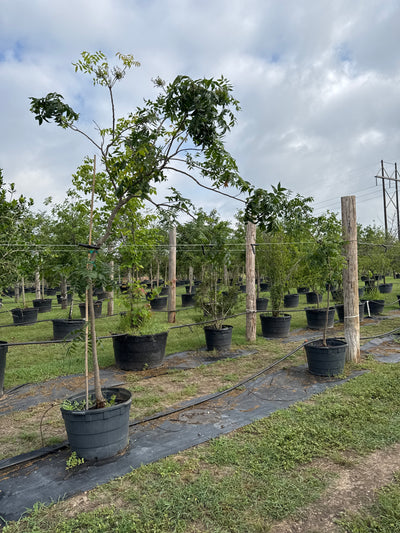

Pomegranate Russian Hardy


Pomegranate Russian Hardy
🌱 Planting Installation
The Russian Hardy Pomegranate (often associated with cultivars like 'Salavatski' or 'Eight Ball') is the "cold-climate survivalist" of the pomegranate world. The Pomegranate Russian Hardy was engineered for northern climates, delivering reliable fruit production where traditional pomegranates struggle. This is its defining feature. It is reliably hardy to USDA Zone 6, surviving temperatures as low as 0°F to 5°F once established. It stays dormant longer in the spring to avoid damage from "false springs." The Russian Hardy is a vigorous, multi-stemmed shrub that can reach 10–12 feet. It is more compact and "bushy" than other varieties, making it an excellent candidate for a productive privacy screen or a sculptural large shrub. This variety produces large, round fruit with a unique blushed-pink to orange-red rind. The arils inside are deep ruby-red, notably sweeter and less acidic than commercial varieties, with softer, more edible seeds. It also features very glossy, leathery dark-green leaves that resist wind-burn. In late spring, it is covered in bright, crepey orange-red flowers that are highly attractive to pollinators. While the 'Wonderful' is the king of the grocery store, the Russian Hardy is the king of the backyard orchard in colder climates.
|
Scientific Name |
Punica granatum 'Russian Hardy' (Salavatski) |
|
Foliage: Deciduous |
Leaves: Small, lance-shaped, and leathery. They are a slightly darker green than 'Wonderful' and have a high gloss that resists wind-burn. Flowers: Large, crepey, orange-red blooms. They are trumpet-shaped and appear in late spring, usually escaping the last frosts. Fruit: Large and round with a blushed-pink to deep red skin. The rind is slightly thinner than the 'Wonderful' variety. Seeds: The arils are ruby-red and very juicy, with a flavor that is often described as "sweeter and less acidic" than commercial types. Bark: Smooth and greyish when young, becoming deeply furrowed and twisting with age. Features protective thorny spurs. |
|
Mature Height |
10 – 12 feet (Slightly more compact than 'Wonderful') |
|
Mature Width (Spread) |
8 – 10 feet |
|
Growth Rate |
Moderate (Focuses energy on wood density over height) |
|
USDA Zone/Chill Hours |
Zone 6 – 10 (Reliably cold hardy down to 0°F - 5°F); Requires 100 – 200 chill hours (Low, but breaks dormancy later than others) |
PLANT CARE & CHARACTERISTICS
Light Requirements: Full Sun. 8+ hours. In colder zones, plant against a south-facing wall to trap "radiant heat." Avoid planting in "frost pockets" (low-lying areas where cold air settles). Elevating the planting site slightly or placing it near a brick or stone structure can provide a 3–5 degree temperature buffer that saves the crop during a surprise freeze.
Water Requirements: Moderate. Regular deep watering for the first 2 seasons. Essential during fruit swell in late summer.
Drought Resistance: High. Once established, it is extremely water-efficient, though fruit size will decrease in drought.
Soil Type: Adaptive. Thrives in well-drained loamy soil but tolerates calcareous (alkaline) and rocky soils well.
Deer Resistance: High. The combination of leathery leaves and thorny spurs makes it unpalatable to most deer
Pest/Disease Resistance: Excellent. Highly resistant to common leaf spots and more tolerant of humidity than 'Wonderful'.
Pollination: Self-Fruiting. Does not require a second tree, though insect activity improves the "fruit set."
Harvest: Mid-to-Late Fall. Typically ripens in October, just before the first hard freeze.
- The Harvest Tip: The fruit is ready when the skin changes from a bright pinkish-red to a burnished, matte red, and the fruit feels heavy for its size. If the rind starts to crack, harvest immediately.
-
Harvesting Before the "Big Freeze": While the tree can handle 0°F, the fruit is mostly water and will turn to mush if it freezes on the branch.
-
The Deadline: If the forecast calls for a "hard freeze" (below 28°F) in late October or November, harvest every pomegranate immediately, even if they look a little pale. They will continue to "cure" and sweeten in storage.
-
YIELD
| Tree Age | Production Phase | Yield (Lbs) | Estimated Fruit Count |
| Year 1 | Establishment | 3 – 6 lbs | 5 – 10 fruits |
| Year 2 | Young Producer | 15 – 30 lbs | 25 – 45 fruits |
| Year 3 | Expanding | 45 – 75 lbs | 60 – 100 fruits |
| Year 4 | Sub-Mature | 85 – 130 lbs | 120 – 180 fruits |
| Year 5+ | Full Maturity | 150 – 200+ lbs | 200 – 300+ fruits |
STORAGE/SHELF LIFE
| STORAGE METHOD | SHELF LIFE | NOTES |
| Countertop (Room Temp) | 2 Weeks | Keep in a cool, dry place out of direct sunlight. |
| Refrigerator (32°F - 40°F) | 2 Months | Wrap in a perforated plastic bag to maintain humidity. |
| Arils (Removed) | 5 – 7 Days | Store in an airtight container; perfect for snacking. |
| Frozen Arils | 12 Months | Best way to preserve the crop for year-round smoothies. |
The Sweeter "Cure": If the fruit tastes too tart immediately after picking, let the rest of the harvest sit in the refrigerator crisper drawer for 14 days. This helps the starch-to sugar conversion continue post-harvest.
PRUNING
1. The "Cold-Safety" Multi-Trunk: Because this variety is grown for its survival in 0°F weather, you want "redundancy" in the structure. It is safer to grow the Russian Hardy as a multi-trunk shrub rather than a single-trunk tree.
- The Selection: From the 15-gallon root ball, identify 3 to 5 main trunks that grow outward in different directions.
- The Logic: If a severe "polar vortex" causes winter-kill on one trunk, the others (and the root system) will survive to carry the crop. A single-trunk tree is far more likely to be lost entirely in a record-breaking freeze.
2. Managing "Tip-Fruiting": Pomegranates fruit on the tips of new growth (spurs). If you "hedge" the plant into a perfect ball in the spring (like a boxwood), you will cut off every single flower bud for the year. Pruning should be selective, not a "haircut."
- The Cut: In late winter, shorten the long, leggy "whips" from last year by about 25-30%.
- The Result: This "tips" the branch and forces the tree to produce many short side-branches (spurs) rather than one long, floppy one. More spurs = more pomegranate flowers.
3. The "Light and Air" Rule: The Russian Hardy is very dense. Without pruning, the center becomes a dark "bird's nest" where fruit can rot and pests can hide.
- The Action: Remove any branches that are crossing through the middle of the plant or rubbing against each other.
- The "V" Shape: Aim for an "open-vase" look. You should be able to stand on one side of the plant and see light through the center to the other side.
4. Sucker Management (The Constant Battle): Like your 'Caroline Raspberries', the Russian Hardy wants to spread. It will send up dozens of "suckers" from the base every year.
- The Protocol: For a professional installation, these must be cut flush with the ground as soon as they appear. If left alone, they will turn the tree back into a 20-stem thicket that produces tiny, seedy fruit. You must be aggressive with "sucker" removal because the suckers can cause the interior of the plant to lack airflow and cause rot in damp autumns.
5. The "Thinning" Rule for Young Trees
- The Problem: The Russian Hardy is so productive it often sets more fruit than its young branches can hold.
- The Fix: If a branch is bending to the ground in August, remove half the fruit. This prevents the "weeping" habit from becoming permanent and protects the tree's structural integrity
6. Tool Tip: Always use high-quality bypass pruners. Anvil-style pruners will "crush" the stems, creating an entry point for Heart Rot (Alternaria) or wood-boring insects
7. Safety Tip: The thorns (spurred branches) on the Russian Hardy are often sharper and more numerous than on the 'Wonderful'. Wear heavy leather gloves when thinning the interior of these 15-gallon pots in the nursery.
PRUNING SUMMARY
| Pruning Phase | Timing | Primary Goal |
| Structural Training | Late Feb / March | Selecting the strongest 3–5 stems to form the "skeleton." |
| Thinning | Summer (June) | Removing "water sprouts" (straight, vertical shoots) that shade the fruit. |
| Maintenance | Post-Harvest | Clearing out the thorny interior to prevent fruit scarring. |