


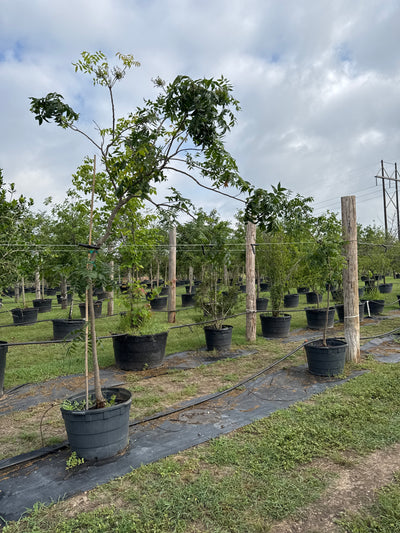


Orange Hamlin Sweet


Orange Hamlin Sweet
Location on Farm:
🌱 Planting Installation
Hamlin Sweet Orange is one of the most widely planted early-season sweet orange varieties in the world. Discovered as a chance seedling in Florida in 1879, it is prized by commercial growers and home orchardists alike for its heavy productivity, cold tolerance, and high juice content. The Hamlin Sweet Orange produces abundant yields of medium-sized, round-to-oblate fruit with pale orange, exceptionally tender flesh. It yields a high volume of sweet, low-acid juice, making it a cornerstone of early-season commercial orange juice production. The fruits are smooth-skinned and virtually seedless (typically 0 to 6 seeds per fruit), holding cleanly on the tree from October through January. Overall, the Hamlin Sweet Orange tree grows into a medium to large tree with an upright, compact canopy, reaching 15 to 20 feet tall (standard) or 8 to 12 feet on semi-dwarf rootstocks. It is completely self-fertile and requires minimal pruning, thriving in full sun and well-draining sandy loam soils.
| Scientific Name | Citrus sinensis 'Hamlin' (Hamlin Sweet Orange) |
| Foliage: Evergreen |
Dense, compact, upright canopy with dark green foliage and small spines/thorns along branches Leaves: Ovate to broad-elliptical, 3–4 inches long; glossy, dark green with narrowly winged petioles Flowers: Small, intensely fragrant, 5-petaled white blossoms borne in clusters in spring. Fruit: Medium-sized, round to slightly oblate sweet orange; smooth, thin, yellow-to-pale-orange peel; tender, exceptionally juicy, pale-yellow-to-orange flesh with mild, sweet flavor Seeds: Nearly seedless (typically 0–6 seeds per fruit) Bark: Smooth, grayish-green on young branches, maturing to smooth gray-brown with subtle horizontal ridges |
| Life Span: Perennial | 50+ years |
| Mature Height | Standard: 15–20 ft; Dwarf/Semi-Dwarf: 8–12 ft |
| Mature Width (Spread) | 10–15 ft (compact, upright, rounded canopy) |
| Growth Rate | Fast to Moderate |
| USDA Zone / Chill Hours | USDA Zones 9a–11 (Cold hardy down to 22°F to 25°F / -4°C to -5°C; more cold-tolerant than Valencia oranges); Requires 100–200 chill hours |
PLANT CARE & CHARACTERISTICS
Light Requirements: Full Sun (8+ hours of direct sunlight daily for optimal juice yield and sugars).
Water Requirements: Moderate; prefers deep, thorough watering during fruit setup and swell; allow top 2–3 inches of soil to dry out between waterings.
Drought Resistance: Moderate once established, but drought during fruit fill leads to fruit drop and smaller fruit.
Soil Type: Deep, well-draining sandy loam or loamy soil; dislikes soggy, poorly drained clay; pH 6.0–7.5.
Deer Resistance: High (Aromatic, oils in foliage and stem spines deter deer).
Pest / Disease Resistance: Moderately resistant to cold stress; susceptible to Citrus Canker, Asian Citrus Psyllid (Huanglongbing/HLB), Scale, and Phytophthora Root Rot.
Pollination: Self-fertile (Self-fruitful); sets heavy crops independently without needing a second pollinator tree.
Harvest: Early season (typically October through January; widely grown as a top early juicing orange).
Yield Timeline by Tree Age
Years 1–2: Minimal to No Yield (It is recommended to strip flowers and young fruitlets during the first 2 years so the tree directs its energy into establishing a strong canopy and root system).
Year 3 (First Harvest): 30 – 60 lbs (~75 to 150 oranges) as the young tree begins setting functional crops.
Years 4–5: 80 – 150 lbs as the branching framework expands.
Years 6+ (Peak Maturity): 200 – 400+ lbs annually when grown under full sun with proper irrigation, nutrition, and pest management.
| Tree Size | Average Annual Yield (Lbs) | Number of Oranges (Approx.) |
| Standard (15–20 ft) | 200 – 400+ lbs | ~500 to 1,000+ oranges |
| Semi-Dwarf (10–12 ft) | 100 – 200 lbs | ~250 to 500 oranges |
| Dwarf / Container (6–8 ft) | 40 – 80 lbs | ~100 to 200 oranges |
Factors Influencing Hamlin Orange Yields
1. High Juicing Efficiency: Because of its dense cropping habit, Hamlin is considered one of the highest-yielding cultivars on a "pounds-solids per acre" basis, making it a favorite for juicing.
2. Fruit Creasing & Heavy Dropping: Hamlin trees produce fruit with very thin skin. During years with extremely heavy crop loads or inadequate potassium levels in the soil, the fruit can suffer from creasing, splitting, or late-season pre-harvest fruit drop.
3. Avoid Over-Pruning: Hamlin trees bear blooms and fruit primarily on outer branch tips. Avoid heavy shearing or structural topping, which destroys flowering wood and significantly reduces the following season's total yield.
4. Water & Nutrition During Swell: Inadequate moisture or nitrogen/potassium deficiencies during summer fruit development result in undersized, dry fruit and higher rate of fruit drop before the fall harvest.
Storage / Shelf Life: Holds well on the tree into mid-winter; stores under refrigeration (45°F–50°F) for 2 to 3 weeks.
Pruning: Very Low maintenance; prune in late winter after harvest to remove deadwood, crossing inner branches, or rootstock suckers below the graft union. Avoid over-pruning as it flowers on branch tips.


