


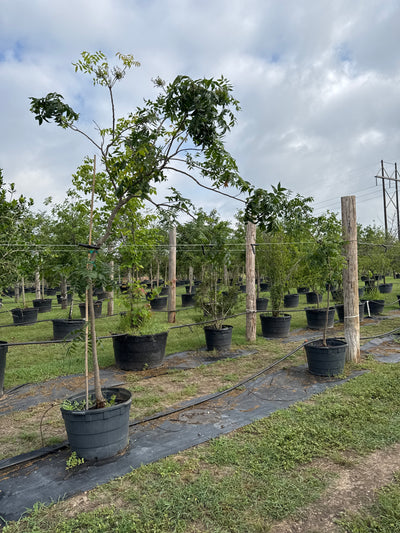

Lemon Eureka Variegated Pink


Lemon Eureka Variegated Pink
🌱 Planting Installation
The Eureka Variegated Pink Lemon is a striking citrus variety that combines ornamental appeal with exceptional fruit quality. While the exterior of the fruit is uniquely striped with green and yellow, the interior flesh features a stunning, delicate salmon-pink hue. It provides a classic, tart Eureka lemon flavor, making it the ultimate ingredient for "boutique" garnishes and natural pink lemonades. The leaves are a masterpiece of variegation, splashed with creamy white and deep emerald green. Perhaps its most enchanting feature is the new growth, which emerges in a vibrant, glowing fuchsia-pink before maturing into its variegated pattern. Unlike standard lemons, the flower buds on the Pink Eureka are a deep violet-purple, opening into highly fragrant, waxy white blossoms. This color contrast provides visual interest even before the tree is in full bloom. It maintains a strong, upright-to-spreading habit. Its moderate growth rate and stunning year-round color make it the perfect "focal point" tree for a sunny courtyard or a protected pool-side landscape.
| Scientific Name | Citrus limon 'Variegated Pink' |
|
Foliage: Evergreen |
Leaves: Stunningly Variegated. Asymmetrical patterns of creamy white, light green, and dark green. New growth often emerges with a bright pink tint. Flowers: Fragrant White. The buds are often tinted purple or pink, opening into pure white, waxy blossoms. Fruit: Striped & Colorful. Immature fruit is striped green and yellow. As it matures, it turns yellow with faint stripes. The flesh is unique pink (resembling a grapefruit). Seeds: Few to None. Typically considered a low-seed variety, making it excellent for culinary use. Bark: Smooth and Gray-Green. Mature trunks develop a slightly rougher texture but remain relatively clean. Thorns are present but usually sparse. |
| Mature Height | 10 – 15 feet (Can be kept much smaller with pruning). |
| Mature Width (Spread) | 8 – 10 feet (Spreading and vigorous). |
| Growth Rate | Moderate. Slightly slower than the standard green Eureka due to less chlorophyll in the leaves. |
| USDA Zone/Chill Hours | Zone 9 – 11 (Sensitive to frost; needs protection below 32°F); Requires 0 chill Hours. Tropical/Subtropical. |
PLANT CARE & CHARACTERISTICS
Light Requirements: Full Sun (with a caveat). Needs 6–8 hours of light, but in extreme heat, the white parts of the leaves can "scorch." Afternoon filtered light is beneficial in Zone 10+.
Water Requirements: Moderate & Consistent. Requires well-regulated moisture. It is less forgiving of "wet-dry" cycles than the hardy 'Loquat'.
- Pro-Tip: Use a moisture meter to check the soil. The soil should be "damp-sponge" moist, not "saturated-sponge" wet.
Drought Resistance: Low. Drought stress leads to immediate leaf drop and "sunburn" on the exposed, striped fruit.
Soil Type: Well-Drained & Sandy Loam. Highly sensitive to "wet feet." Requires a slightly acidic pH (5.5–6.5). Do not to over-fertilize with high-nitrogen salts in an attempt to make it grow faster. Rapid, forced growth often causes the leaves to come out solid green (reverting), as the tree tries to compensate for the lack of chlorophyll. A slow, steady organic citrus fertilizer is better.
Deer Resistance: Moderate. While the citrus oils and occasional thorns provide some protection, the tender pink new growth is attractive to browsers.
Pest/Disease Resistance: Fair. Vulnerable to Citrus Leaf Miner (which is very visible on the variegated leaves) and Scale. If you see the pink tips of the leaves curling, check immediately for Aphids, as they gravitate toward this variety's softer tissue.
Pollination: Self-Fertile. Produces fruit reliably without a second tree.
Harvest: Year-Round (Peak Winter/Spring). Like most Eurekas, it provides fruit in waves, though the heaviest crop is in the cooler months.
- The "Green-to-Gold" Stripe Shift: Harvest when the green stripes begin to fade into a light yellow, and the background turns a vibrant "lemon" yellow. This is when the interior pink pigment is most pronounced. If left on the tree too long, the stripes disappear entirely, and the fruit looks like a standard lemon.
YIELD
| Tree Age | Production Phase | Yield (Lbs) | Estimated Fruit Count |
| Year 1 | Establishment | 3 – 5 lbs | 10 – 15 striped lemons |
| Year 2 | Expanding | 10 – 20 lbs | 30 – 60 lemons |
| Year 3-4 | Sub-Mature | 30 – 50 lbs | 100 – 150 lemons |
| Year 5+ | Full Maturity | 70 – 100 lbs | 200+ lemons |
STORAGE/SHELF LIFE
| STORAGE METHOD | SHELF LIFE | NOTES |
| Countertop (Display) | 7 – 10 Days | Best for showing off the green/yellow stripes in a bowl. |
| Refrigerator (Crisper) | 4 – 5 Weeks | Retains moisture best; prevents the thick rind from becoming "woody." |
| Sliced & Frozen | 3 – 4 Months | Freeze slices on a tray then bag; perfect for colorful garnishes. |
| Juiced & Frozen | 6+ Months | The juice is clear to very pale pink; freeze in cubes for "Pink Lemonade." |
PRUNING
1. The "Reversion" Critical Check: This is the most important maintenance task for this specific tree.
- The Action: Look for any branch that is producing solid green leaves with no white or cream patterns.
- The Technique: Trace that branch back to the main trunk and prune it off entirely.
- The Reason: Solid green branches grow 2–3 times faster than variegated ones. If left alone, they will quickly dominate the tree, and you will lose the "Variegated" part of your Pink Eureka.
2. Managing "Sun-Exposure" Pruning: Because the white parts of the leaves can sunburn, you don't want to open the canopy too much.
- The Strategy: Use a "Light Thinning" approach. Instead of the "Open Vase" style used for nectarines, keep a slightly denser outer canopy to provide "self-shade" for the interior branches and striped fruit.
- The Benefit: This prevents the striped lemons from developing brown "sunscald" patches on their skins.
3. Thining for "Pink" New Growth: Since the most colorful pink growth happens at the tips of the branches, you want to encourage as many "tips" as possible.
- The Technique: "Pinch" or snip the top 2 inches of new growth flushes.
- The Result: This forces the branch to split into two or three new shoots, tripling the amount of vibrant pink foliage visible to the client.
4. "Skirting" for Pests: Like the 'Meyer Lemon', the Pink Eureka’s branches will bow under the weight of fruit.
- The Action: Keep the lowest branches at least 12–15 inches off the ground.
- The Reason: Variegated leaves are highly attractive to snails and slugs. Keeping a clear "trunk" area makes it easier for the client to apply copper tape or organic barriers to stop pests from climbing into the canopy.
PRUNING SUMMARY
| Pruning Type | Timing | Primary Goal |
| Reversion Pruning | Year-Round | High Priority: Removing solid-green shoots to preserve variegation. |
| Thinning | Early Spring | Improving light penetration to prevent "shading out" inner branches. |
| Light Heading | Summer | Snipping the ends of long branches to encourage a bushier habit. |