


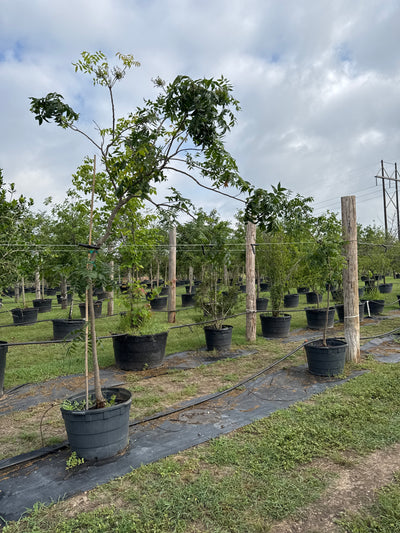


Butterfly Bush Nanho Blue


Butterfly Bush Nanho Blue
Location on Farm:
🌱 Planting Installation
The 'Nanho Blue' Butterfly Bush is a vigorous, compact deciduous shrub renowned for its exceptional ability to draw butterflies, bees, and hummingbirds to the garden. It delivers all the high-impact beauty of the classic butterfly bush but in a much more manageable, landscape-friendly size. It features elegant, lance-shaped leaves with a striking silvery, blue-gray to sage-green finish on top and a soft, fuzzy white texture underneath. This unique coloration gives the entire bush a lovely, shimmering appearance in the garden landscape. From early summer until the first hard frost, it produces massive, cone-shaped flower spikes (6 to 10 inches long) that heavily arch the branches. The individual florets are a rich, mauve-lavender blue with a bright amber-orange center eye, emitting a sweet, honey-like fragrance. It has a fast, vigorous growth rate but matures into a neat, compact mound of 3 to 5 feet tall and wide—making it ideal for smaller perennial borders, foundation plantings, or mass groupings where standard 10-foot butterfly bushes would easily overwhelm the space.
| Scientific Name | Buddleja davidii 'Nanho Blue' (Synonym: Buddleja davidii 'Mongo') |
| Foliage: Deciduous to Semi-Evergreen |
Leaves: Deciduous to semi-evergreen (in mild winters). The leaves are finely toothed, narrow, and lanceolate (spear-shaped), measuring 4 to 8 inches long. They feature a beautiful, distinctive silvery, sage-green to blue-gray finish on top, while the undersides are covered in a soft, fuzzy white coating (tomentum). Flowers: Intensely fragrant and honey-scented. They bloom from early summer until the first hard frost, forming long, cone-shaped terminal spikes (panicles) measuring 6 to 10 inches long. The individual tiny florets are a striking mauve-blue to rich lavender-blue, accented by a warm amber-orange center eye. Seeds: Following pollination, the flowers give way to elongated, dry, two-valved seed capsules. They start green-brown, turning a dry, brittle brown by late autumn. Each dry fruit capsule splits open when ripe to release roughly 50 tiny, dust-like, winged seeds. These seeds are extremely light and designed to be easily carried away by the wind. Bark: On young stems, the wood is smooth, square-angled (quadrangular), and covered in soft hairs. As the main wood ages, it matures into a light pale grey-brown bark that becomes prominently flaky and deeply fissured on old trunks. |
| Life Span: Perennial | Typically a short-to-medium-lived woody perennial, living 10 to 20 years. However, because it vigorously regrows entirely from its root system, its effective garden presence can last much longer. |
| Mature Height | 3 to 5 feet (If never pruned, it can occasionally stretch up to 6 feet, but annual pruning easily keeps it at a neat, compact 3 to 4 feet). |
| Mature Width (Spread) | 3 to 5 feet (Forms a beautiful, naturally rounded shape with elegant, arching branches that weep slightly under the weight of the flower spikes). |
| Growth Rate | Fast / Vigorous. Even if cut back entirely to the ground in late winter, it will rocket up 3 to 5 feet and fully bloom by mid-summer of the exact same year. |
| USDA Zone | Zone 5 through 9 (In cold Zones 5 and 6, it will routinely freeze and die completely back to the ground in winter, acting like an herbaceous perennial by shooting fresh growth straight up from the roots in spring). |
PLANT CARE & CHARACTERISTICS
Light Requirements: Full Sun. It absolutely demands 6 to 8+ hours of direct daily sunlight. If planted in partial shade, the stems will become weak, leggy, and floppy, and the plant will produce significantly fewer flower spikes.
Water Requirements: Low to Moderate. Needs regular watering during its first growing season to establish a deep root system. Once established, it prefers to dry out between waterings. Follow the "soak and dry" rule—watering deeply but infrequently. Overwatering is a quick way to kill a butterfly bush.
Drought Resistance: High / Excellent. Once its root system is established, 'Nanho Blue' handles intense summer heat waves and dry spells beautifully without drooping or losing its vibrant flower output.
Soil Type: Adaptable to poor, sandy, gravelly, or rocky soils, but absolutely requires sharp, flawless drainage. It prefers a neutral to slightly alkaline pH (6.5 to 7.5). It will quickly develop root rot and die if planted in heavy, compacted clay or any site where water pools after a rainstorm.
Deer Resistance: Excellent / Very High. Deer and rabbits will completely ignore this plant. The rough, fuzzy texture of the silvery-blue leaves and the presence of bitter glycosides make it entirely unpalatable to browsing wildlife.
Pest/Disease Resistance: Superior / Very Low-Maintenance. Generally pest-free. However, during exceptionally hot, dry, and dusty mid-summer weeks, it can occasionally attract spider mites, which can be easily managed by blasting the undersides of the leaves with a sharp stream of water from a garden hose. Virtually free of major diseases, provided it has excellent soil drainage. Its only notable threat is Phytophthora root rot if it is forced to sit in soggy, waterlogged soil.
POLLINATION
1. Primary Pollinators: Butterflies (such as Monarchs, Swallowtails, and Painted Ladies), Long-Tongued Bees (Honeybees and Bumblebees), and Hummingbirds.
2. The Flower Structure: Each large, cone-shaped flower spike is made up of hundreds of tiny, tube-shaped florets. The male stamens (pollen-makers) and the female pistil are hidden deep at the very bottom of these narrow floral tubes, completely shielded from the wind and light-rain.
3. Pollinator Reward: High-Sugar Nectar. 'Nanho Blue' produces a sweet, honey-scented nectar that is exceptionally rich in sucrose. Because the nectar is located at the bottom of a long, narrow tube, it is inaccessible to short-tongued insects (like beetles or flies). It can only be reached by creatures with long proboscises (butterflies/moths) or long tongues (bees/hummingbirds).
4. Visual Targeting (The "Orange Eye" Beacon): The individual mauve-blue flowers feature a distinct, bright amber-orange center. This orange center acts as a literal target marker for incoming pollinators, guiding them directly to the mouth of the tube where the nectar and pollen sit.
5. Self-Fertility: Highly Self-Fertile. 'Nanho Blue' can successfully pollinate itself using pollen from the same floret, the same spike, or a neighboring branch. It does not require another butterfly bush variety nearby to set seed.
6. Seed Formation: Once a floret is successfully pollinated, it dries up and forms a small, brittle brown capsule. By mid-to-late autumn, these capsules split open to scatter tiny, winged seeds that are easily distributed by the wind.
PRUNING
Pruning 'Nanho Blue' Butterfly Bush is the absolute secret to keeping this plant looking like a neat, compact flower factory rather than a wild, tangled mess. Because this cultivar is naturally dwarf and compact (reaching only 3 to 5 feet), it requires much less effort than standard 10-foot varieties, but it still thrives on aggressive cutting. Because 'Nanho Blue' blooms exclusively on "new wood" (the fresh, green stems that shoot up in the current spring), you never have to worry about accidentally cutting off next summer's flowers.
1.The Hard Annual Chop (The Yearly Reset)
- When? Late Winter/Early Spring (Right as the coldest weather breaks and you see tiny green buds just starting to swell at the base).
- How? Use sharp loppers or a hand saw to cut the entire plant back hard—leaving stubs only 12 to 24 inches off the ground.
- Why? This hard pruning accomplishes three things: it clears away wood that was battered by winter, keeps the plant at a tidy 3-to-4-foot height, and forces a massive explosion of vigorous new stems. More new stems mean a much higher concentration of large, showy summer flower spikes.
2. Deadheading (The Continuous Bloom Trick)
- When? Throughout Summer (From July through September, as soon as individual flower spikes turn brown).
- How? Use hand pruners to snip off the faded, browning flower spikes. Cut the stem back to the next set of green leaves or side buds.
- Why? This intercepts the plant before it spends its energy creating seeds. It signals the bush to immediately push out a brand new wave of side-shoots, keeping your 'Nanho Blue' covered in fresh blue blossoms all the way until the first hard autumn frost.
3. Sanitation Clean-up (Disease Prevention)
- When? Late Autumn (After the first hard killing frost has turned the foliage black).
- How? Lightly trim off the very tips of the branches to remove any leftover seed heads.
- Why? Optional but highly recommended. Removing the seed heads in late autumn ensures winter winds won't scatter seeds across your garden, preventing the plant from self-seeding where it shouldn't.
4. The Golden Rule: Avoid Fall Pruning
- Never chop your butterfly bush back hard in the autumn. Cutting open the main woody framework right before freezing weather arrives makes the plant highly vulnerable to severe winter dieback.
- If moisture gets trapped inside the freshly cut, hollow stems and freezes, it can split the wood right down to the root crown, potentially killing the entire plant. Always leave the old woody structure intact through the winter to act as a protective buffer, and save the major haircut for early spring.