


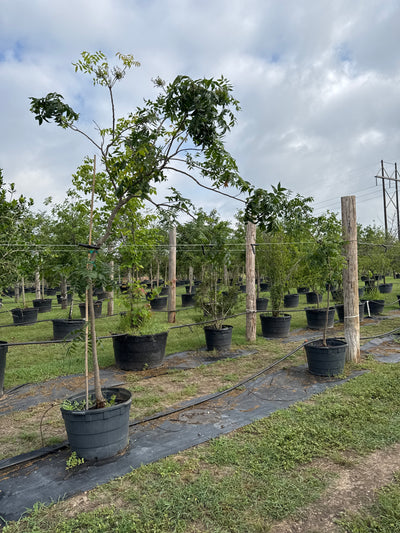


Blackberry Prime Ark 45


Blackberry Prime Ark 45
Location on Farm:
🌱 Planting Installation
Blackberry 'Prime-Ark® 45' a revolutionary variety from the University of Arkansas. It is a rugged, hardworking blackberry bush that looks and behaves much more like a wild bramble than the sleek, thornless varieties. It is an upright, "erect" shrub, it grows stiff vertical canes that stand tall rather than trailing along the ground. Blackberry Prime-Ark® 45' is a primocane-fruiting variety, meaning it can produce fruit on both new wood and old wood, effectively giving you two harvests per year in some climates. This is one of the "stiffest" blackberry varieties. It can often be grown without a trellis if "tipped" (pruned at the top) to encourage branching. The berries have the classic "wild" blackberry flavor—a perfect balance of intense sweetness with a sharp, tangy finish. This plant is a great addition to any home garden.
|
Scientific Name |
Rubus fruticosus 'Prime-Ark 45' |
|
Foliage: Deciduous |
Leaves: The leaves are a deep, rich green with a prominent serrated edge. They typically grow in clusters of 3 to 5 leaflets. The foliage is very dense, providing excellent sun protection for the developing fruit. Flowers: Large, beautiful white blossoms with five petals. Because it is a primocane-fruiter, you will see flowers in the spring (on old wood) and again in the mid-to-late summer (on new wood). These flowers are highly attractive to pollinators. Fruit: The berries are exceptionally large, elongated, and a deep, glossy black. They are known for their firmness and "shipping quality," meaning they don't leak juice easily. The flavor is a classic, sweet-tart blackberry profile with high sugar content when fully ripe. Seeds: While all blackberries have seeds (drupelets), the Prime-Ark 45 is bred to have relatively small seeds for its size, which enhances the fresh-eating experience. Canes: Heavily armed with thorns. The canes are thick and sturdy, often tinged with a reddish-purple hue where they catch the sun. Because they are so rigid, the plant looks like a dense, thorny thicket. Unlike "trailing" blackberries, these grow vertically like a shrub but benefit greatly from a trellis to support the heavy fruit loads. |
|
Mature Height |
4 – 5 feet (Erect canes) |
|
Mature Width (Spread) |
3 – 4 feet (Clumping) |
|
Growth Rate |
Fast |
|
USDA Zone/Chill Hours |
Zone 4-9; While 'Prime-Ark 45' is very hardy, the pollen can become sterile if temperatures consistently stay above 85°F to 90°F during the late-summer flowering period. If you live in a very hot area, your fall crop may be smaller than your summer crop; requires approximately 300 chill hours (32-45°F during the winter). |
PLANT CARE & CHARACTERISTICS
Light Requirements: Full Sun. Requires at least 6–8 hours of direct sun. In very hot climates (Zone 9+), afternoon sun can sometimes scorch the blossoms of the late-summer crop, so a little dappled shade in the late afternoon can be helpful.
Water Requirements: Moderate to High. Like all blackberries, it needs consistent moisture to produce juicy fruit. Because it fruits over a longer period than 'Natchez', you must stay diligent with watering through the heat of late summer.
Drought Resistance: Low. Drought will quickly lead to fruit "mummification" (drying up on the vine). Mulching is critical.
Soil Type: Well-Drained & Slightly Acidic. Prefers a pH of 6.0–6.5. It thrives in loamy soil rich in organic matter. Avoid low spots where water collects.
Deer Resistance: Moderate. Unlike the Natchez, 'Prime-Ark 45' has thorns. These spines provide a natural deterrent that makes it much more deer-resistant than thornless varieties.
PEST/DISEASE RESISTANCE
| STORAGE METHOD | RESISTANCE | NOTES |
| Orange Rust | Immune | To date, no orange rust has been observed on Prime-Ark 45. This is a huge advantage, as orange rust is systemic and usually requires the destruction of the entire plant. |
| Anthracnose | High | It shows only "slight susceptibility" to this common fungal disease. You might see occasional purplish spots on canes, but it rarely impacts the fruit. |
| Double Blossom (Rosette) | Unknown/Resistant | While formal data is limited, many Arkansas varieties show high resistance. The primocane-fruiting habit actually helps here: if you mow the canes to the ground in winter, you break the life cycle of this fungus. |
| Fruit Rot (Botrytis/Grey Mold) | Moderate | Because the berries are exceptionally firm and have low "leakage," they resist mold better than softer varieties like the Natchez. |
| Spotted Winig Drosophila (SWD) | High Risk (Fall Crop) | While the June harvest often "escapes" the worst of these fruit flies, the fall crop (August–October) happens exactly when their population is highest. Harvest fruit as soon as it’s ripe and never leave "culls" (dropped fruit) on the ground. |
| Stink Bugs | Moderate | These are common in late summer. They pierce the drupelets, which can leave a bitter taste or "foul" the fruit with their defensive scent. |
| Japanese Beetles | Moderate | They love the lush foliage of the Prime-Ark 45. Hand-picking them into a bucket of soapy water in the early morning is the most effective organic control. |
| Broad Mites | Occasional | In very hot, dry summers, these can cause the new leaves to curl or look distorted. |
The "White Drupelet" Abiotic Factor- While not a "disease," Prime-Ark 45 is susceptible to White Drupelet Disorder (where individual bumps on the berry turn white).
- The Cause: This is caused by intense UV light and heat (above 85°F to 90°F) combined with low humidity.
- The Fix: Because Prime-Ark 45 has dense foliage, the leaves usually shade the berries. However, if you prune too heavily or have an extreme heatwave, you may see some "sunscald" on the exposed side of the fruit.
Growth Habit: Erect. This is one of the "stiffest" blackberry varieties. It can often be grown without a trellis if "tipped" (pruned at the top) to encourage branching, though a simple wire support still helps with heavy fruit loads. An established Prime-Ark 45 looks more like a freestanding hedge than a vine. It doesn't "weep" or sprawl as much as other varieties, though it will bow slightly under the weight of a heavy harvest.
- Trellis Note: Because Prime-Ark 45 is very vigorous and upright, a T-Trellis (two wires about 3 feet apart) is highly recommended. This keeps the thorny canes contained and prevents them from leaning over into your walking path.
Pollination: The Prime-Ark 45 is self-pollinating (self-fertile). This means you do not need to plant a different variety of blackberry nearby to get a harvest. A single plant can produce both its summer and fall crops entirely on its own.
-
The "Optional Partner" Benefit- Even though it is self-fertile, having other blackberries nearby can offer a few subtle advantages:
- Enhanced Yield: Some growers find that having other varieties nearby can slightly increase the overall size and number of berries through "pollination insurance."
- Extended Harvest: Since you already have varieties like 'Natchez', 'Arapaho', and 'Ouachita', the Prime-Ark 45 fits perfectly into your collection. These other varieties will bloom around the same time as the Prime-Ark 45's summer crop, providing a diverse pollen source.
The Double Harvest- The standout feature of the 'Prime-Ark 45'. Because this variety fruits on both old wood (floricanes) and new wood (primocanes), you essentially get an early summer harvest and a late summer/fall harvest.
- Summer Crop (Early June): It fruits on "floricanes" (last year's wood) in early summer. If you look at the bush in late summer, you will see a unique sight: old wood at the bottom might be finished fruiting, while the fresh green tips at the very top of the plant are just beginning to flower and produce a second round of berries.
- Fall Crop (Early August): It fruits on "primocanes" (the new growth from the current season) in late summer/early autumn, continuing until the first frost.
YIELD
| Category | Typical Yield per Plant | Commercial Equivalent |
| Summer Crop | 4–6 lbs | Comparable to high-yielders like Natchez. |
| Fall Crop | 2–4 lbs | Heavily dependent on "tipping" and summer heat. |
| Total Annual Yield | 6–10 lbs | Roughly 10–15 standard grocery clamshells. |
Factors That Influence Your Yield
-
The "Tipping" Boost: To reach that 10-lb-per-plant potential, you must prune (tip) the new primocanes in the summer.
- First Tip: When canes reach 12–15 inches.
- Second Tip: When side branches reach 12–15 inches.
- The Result: This forces the plant to branch out, creating more "fruiting sites" and doubling your fall berry count.
- Heat Sensitivity: If your summer is extremely hot (sustained 90°F+), the primocane flowers may struggle to set fruit. However, the plant is resilient; any energy it doesn't spend on the fall crop will be "banked" to produce an even larger summer crop the following June.
- Firmness Advantage: Unlike some varieties that lose weight due to "leakage" or softening in the sun, Prime-Ark 45 berries are incredibly firm. This means more of the fruit you pick actually makes it to the kitchen in usable condition.
STORAGE/SHELF LIFE
| STORAGE METHOD | SHELF LIFE | NOTES |
| Countertop | 1–2 Days | While firm, the high sugar content leads to fermentation if left in the heat. Best consumed immediately if not refrigerated. |
| Refrigerator | 7–10 Days | This is the "Gold Standard" for blackberry storage. Most blackberries degrade after 3-5 days, but Prime-Ark 45 stays "snappy" and leak-free for much longer. |
| Freezer | 10–12 Months | Because of its firmness, it holds its shape remarkably well after thawing. It is excellent for "IQF" (Individually Quick Frozen) processing. |
Best Practices for Maximum Freshness
- The "Pink-Nose" Rule: If you harvest the berry when it is still slightly reddish at the tip, it will be very tart but will last nearly 14 days in the fridge. For the best flavor, wait until it is fully black and dulls slightly—at this stage, it will still last a full week.
- Avoid the "Berry Crush": Even though they are firm, do not stack them more than 3 layers deep in a container. The bottom layer needs to breathe.
- The Moisture Barrier: Never wash these berries until the exact second you are ready to eat them. Moisture trapped in the tiny "drupelets" (the bumps) is the number one cause of premature spoilage.
- Cooling Down: If you harvest during a hot August afternoon, let the berries sit on a cool counter for 30 minutes before putting them in the fridge. This prevents "thermal shock," which can cause the berries to sweat inside the container.
PRUNING
Because the Prime-Ark 45 is a thorny, primocane-fruiting variety, pruning it is a bit more involved than your thornless varieties like Natchez or Ouachita. The "tipping" process is the secret to moving from a "good" harvest to a "massive" one.
1. Safety First: The Gear- Since this variety has sharp prickles, do not attempt to prune without:
- Thick leather gloves (gauntlet style to protect your wrists).
- Long sleeves and heavy denim.
- Sharp bypass loppers or hand pruners.
2. Summer "Tipping" (To Double Your Fall Yield)- Tipping is the most important step for Prime-Ark 45. It breaks "apical dominance," forcing the tall, single cane to branch out into a "bush" shape.
-
The First Tip (Early Summer): When the new green primocanes reach 12–15 inches tall, pinch or cut off the top 1–2 inches.
- Result: This forces the cane to send out several horizontal side branches.
-
The Second Tip (Mid Summer): When those new horizontal side branches reach 12–15 inches long, "tip" them again.
- Result: This turns one cane into a structure with dozens of fruiting tips, effectively doubling or tripling your fall crop.
3. Winter Pruning (The "Clean Up")- In January or February, while the plant is dormant, you need to manage the two types of canes:
- Step 1: Remove Spent Floricanes: Find the canes that produced fruit during the previous summer (they will have dead fruit clusters and peeling bark). Cut these all the way to the ground. They will never fruit again and only serve to harbor pests.
- Step 2: Thin the New Canes: Look at the green canes that grew over the last summer. If they are crowded, keep the 5–6 strongest canes per foot of row and remove the spindly ones.
- Step 3: Shorten the Laterals: Trim the side branches (the ones you "tipped" in summer) back to about 12–18 inches. This keeps the heavy fruit closer to the sturdy main cane so it doesn't snap under the weight.
4. The "Alternative" Method: The Total Mow-Down- If you only care about the Fall (Primocane) crop and want to save time:
- In late winter, you can simply mow all canes to the ground.
- Pros: It is much faster, eliminates "Double Blossom" disease, and you don't have to deal with thorns as much.
- Cons: You completely lose your June/July summer harvest.
PRUNING CHECKLIST
| SEASON | ACTION | GOAL |
| Early Summer | Tip new canes at 15" | Create side branches |
| Mid Summer | Tip side branches at 15" | Multiply fruiting sites |
| Late Winter | Cut old (dead) wood to ground | Disease control/Airflow |
| Late Winter | Thin new canes to 5-6 per foot | Increase berry size |