


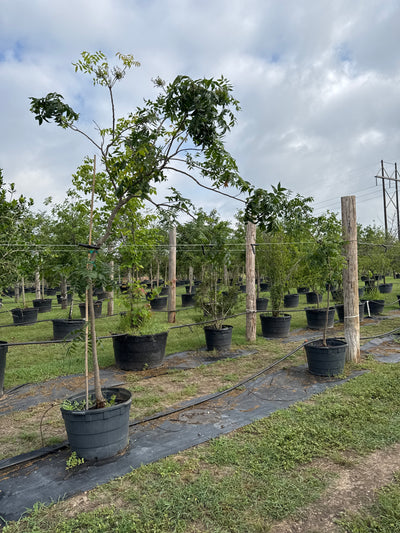


Avocado Mexicola Grande


Avocado Mexicola Grande
The Mexicola Grande Avocado is a legendary, exceptionally cold-hardy Mexican-race avocado variety. It is highly celebrated by backyard orchardists for its ability to withstand freezing winter temperatures that would easily kill standard commercial varieties like the Hass. An improved, larger-fruited sport of the original 'Mexicola' seedling, it is an outstanding choice for growers in USDA Zones 8a and 9. The tree produces medium-sized, glossy, pear-shaped to elongated-ovoid fruit with paper-thin, completely smooth skin that turns a deep, striking jet-black when fully ripe. The pale green flesh has an incredibly high oil content, delivering a remarkably rich, buttery, and intensely nutty flavor that is widely considered among the finest of all cold-hardy avocados. One unique feature is its glossy black skin is paper-thin and entirely lacks the bitter tannins making it completely edible. The fruit can be eaten whole like a plum, with the skin adding a unique, subtle hint of spicy anise (licorice) flavor to the creamy flesh. The Mexicola Grande Avocado is a highly vigorous, fast-growing tree with an upright-to-rounded and spreading canopy. If left unpruned, it can quickly reach heights of 25 to 35 feet, forming a beautiful, lush landscape specimen.
| Scientific Name | Persea americana 'Mexicola Grande' |
|
Foliage: Evergreen |
Leaves: Evergreen, glossy, and deep forest green. True to its pure Mexican-race lineage, the foliage releases a strong, highly aromatic anise (licorice) scent when crushed or bruised. Flowers: Small, multi-branched clusters of greenish-yellow blossoms. It is a Type A flowering variety, opening as female in the morning and male the following afternoon. Fruit: Medium-sized, pear-shaped to elongated-ovoid. It features paper-thin, smooth, glossy black skin. The flesh is creamy with an exceptionally high oil content and a rich, nutty flavor. Seeds: Features a single, relatively large seed that fits loosely within the cavity of the mature fruit. Bark: Smooth and vibrant green on young, tender branches; transitions to a light grayish-brown, slightly textured, and fissured bark on mature trunks. |
| Life Span: Perennial | 50 to 150+ years under optimal growing conditions, maintaining strong production for decades. |
| Mature Height | 25 to 35 feet if left unpruned, though it can easily be maintained at a lower height for home orchards. |
| Mature Width (Spread) | 15 to 20 feet, developing a beautiful, upright-to-rounded and spreading canopy. |
| Growth Rate | Fast. It is a vigorous grower that establishes its frame and canopy much quicker than standard commercial varieties. |
| USDA Zone/Chill Hours | Zone 8a to 11. It is incredibly frost-resilient, with mature trees safely tolerating temperatures as low as 15°F to 18°F for short durations. Requires roughly 100–200 chill hours. It triggers flowering based on seasonal warming trends rather than prolonged cold. (Low-chill) |
PLANT CARE & CHARACTERISTICS
Light Requirements: Full Sun. Requires a minimum of 8–10 hours of direct sunlight daily. Maximum sun exposure is critical for optimizing photosynthesis, driving its fast growth rate, and encouraging heavy flower production.
Water Requirements: Moderate. Needs regular, deep watering during the spring flowering and summer fruiting phases. However, it is sensitive to overwatering and should be allowed to dry out slightly between watering cycles.
Drought Resistance: Moderate to High (For an Avocado). Thanks to its pure Mexican-race lineage, a mature and established Mexicola Grande possesses some of the highest drought tolerances among avocado varieties, though extended drought will still trigger fruit drop.
Soil Type: Excellent Drainage Imperative. Prefers loose, sandy loam, or gravelly soils with a neutral to slightly acidic pH. It cannot tolerate heavy clay, hardpan, or soggy, waterlogged conditions which suffocate the roots.
Deer Resistance: Low. Deer will readily browse the tender new leaf flushes and young green twigs. Young trees should be protected with physical fencing or cages until the lower canopy grows above their reach.
Pest/Disease Resistance: Moderate. Highly resilient against cold-induced root stress, but remains susceptible to Phytophthora (Root Rot) if planted in poorly draining soil. It exhibits typical vulnerability to common orchard pests like mites, thrips, and avocado lace bugs.
POLLINATION
The "Type A" Flowering Cycle: Like all avocados, the Mexicola Grande uses a time-separated gender system (protogynous dichogamy) to encourage cross-pollination.
- Day 1 (Morning): The flower opens for the first time as Female (receptive to pollen). It then closes at midday.
- Day 1 (Afternoon): The flower remains closed.
- Day 2 (Afternoon): The exact same flower re-opens as Male (shedding pollen).
Because its female stage occurs in the morning and its male stage occurs the following afternoon, it operates on a schedule that perfectly complements Type B varieties.
| Feature | Details |
| Flowering Type | Type A |
| Primary Pollinator | Honeybees, solitary bees, hoverflies, and wasps. |
| Self-Fertility | Moderate to High. In regions with cooler, variable spring temperatures, the morning and afternoon schedules often "bleed" together, creating a natural overlap where a single tree can pollinate itself successfully. |
| Best Cross-Pollinator | Type B Varieties. To achieve maximum commercial-grade yields, plant it near a Type B variety whose flowers release pollen in the morning. |
| Ideal Partners | Joey, Bacon, Zutano, or Fuerte. |
HARVEST
The Mexicola Grande Avocado features a relatively rapid fruit-development cycle compared to commercial varieties like the Hass. Because it is a pure Mexican-race variety, it blooms early in the spring and ripens its fruit quickly, allowing you to harvest the entire crop in the late summer before any threat of early winter frosts.
| Feature | Details |
| Harvest Window | Typically Late Summer to Early Fall (usually August through October, depending on your local climate). |
| Ripening Style | Climacteric. The fruit matures on the branch but will not soften or become edible until after it is harvested from the tree. |
| Visual Indicator | The skin undergoes a dramatic color shift, transitioning from a glossy forest green to a deep, dark purple or jet black. |
| Texture Indicator | The skin is paper-thin and completely smooth. When fully mature, the glossy sheen dulls slightly to a satin or matte finish. |
How to Determine Fruit Maturity
Because the Mexicola Grande has an exceptionally thin skin, leaving it on the tree too long can cause it to over-ripen on the branch or become a target for wildlife. Use these steps to gauge the perfect harvest window:
1. Monitor the Color Change: Wait until a significant portion of the fruit on the tree has fully turned dark purple or black.
2. Listen for the Seed: In some mature Mexicola Grande fruits, the large seed fits somewhat loosely in the cavity. If you gently shake a picked, mature fruit, you can sometimes feel or hear the seed rattle slightly.
3. The Countertop Sample: Pick 2 or 3 fully dark fruits. Place them on the kitchen counter at room temperature.
- If they soften to a perfect, buttery consistency within 3 to 5 days without shriveling, your crop is officially ready to harvest.
Harvesting Best Practices for a Delicate Variety
1. Never Pull the Fruit: Because the skin is paper-thin, pulling the fruit can easily tear the skin around the stem, exposing the rich flesh to immediate rot. Always use sharp hand pruners to clip the stem, leaving a 1/4-inch stub (the "button") attached to the fruit.
2. Handle with Extreme Care: The skin lacks the durable, woody armor of a Hass. Rough handling or dropping the fruit into a hard bucket will cause deep, internal bruising. Use a padded picking pole or gently place the harvested fruit into a lined basket.
3. Harvest Promptly: Unlike Hass avocados, which can "store" on the tree branches for months, the Mexicola Grande should be harvested relatively promptly once mature. Leaving them hanging too far into the autumn can cause the high-oil flesh to take on a watery texture or cause the fruit to drop prematurely.
YIELD
| Tree Status | Expected Yield (Fruit Count) | Development Focus |
| Rapid Framework Building: Years 1-2 | 0 Fruit | Vegetative Growth. Strip away any spring flowers or tiny pea-sized fruits immediately. Because this variety grows fast, it needs to put 100% of its energy into building strong structural branches that won't snap under fruit weight later. |
|
First Harvest: Year 3 |
15 – 25 Fruit | The first true sample of fruit. The tree is expanding rapidly and starting to form its characteristic rounded shape. |
| Adolescent Production: Year 4 | 40 – 70 Fruit | Canopy volume increases significantly, and the root system is well established. |
| Early Maturity: Years 5-7 | 100 – 200 Fruit | The tree enters steady, reliable production, yielding roughly 50 to 80 lbs of fruit annually. |
| Full Maturity: Year 10+ | 300 – 400+ Fruit | At peak maturity, a well-managed Mexicola Grande can produce 150+ lbs of fruit. Because it grows larger than the semi-dwarf Joey, its total mature fruit volume per tree is naturally higher. |
STORAGE/SHELF LIFE
| Stage | Storage Method | Shelf Life | Special Considerations |
| Unripe (Hard Green-Black) |
Room Temperature (Countertop) | 3-5 days | Ripens very quickly. Keep in a single layer out of direct sunlight. |
|
Unripe (Hard |
Refrigerator |
Up to 5–7 days | Susceptible to "chill injury" (sunken black spots) if kept below 40°F for too long. |
| Ripe (Soft/Jet Black) | Room Temperature (Countertop) | 1-2 days | Must be consumed almost immediately; the thin skin offers zero barrier to over-ripening. |
| Ripe (Soft/Jet Black) | Refrigerator (Airtight Container) | 2-3 days | High oil content keeps it creamy, but the flesh near the skin can oxidize quickly if delayed. |
| Cut (Open Fruit) | Refrigerator (Sealed) | 1 day | Highly reactive to oxygen. Skin can be left on since it is edible, but the flesh browns fast. |
Essential Best Practices for Your Harvest
1. The Single-Layer Rule: Never stack unripe Mexicola Grande avocados in a deep bowl or basket. Because the skin is so delicate, the sheer weight of the fruits pressing against one another will cause deep, internal bruising long before they finish softening. Always spread them out in a single layer on a flat surface or tray while they ripen.
2. Gauging Maturity Without Bruising: Standard avocados are often checked for ripeness by squeezing the center of the fruit, but doing this to a Mexicola Grande will instantly ruin the flesh.
- The Technique: Check for ripeness by applying incredibly gentle pressure exclusively at the neck of the fruit right around the stem stub. If it yields slightly to your thumb there, it is ready to eat.
3. Managing the Edible Skin: Because the skin is paper-thin and lacks the bitter tannins found in thick-skinned varieties like the Hass, the skin of the Mexicola Grande is entirely edible. Since the skin is edible and carries a unique, pleasant hint of anise (licorice) flavor, you don't need to peel it. However, because you are eating the skin, wash the fruit gently with cool water just before cutting, and avoid using any topical chemical sprays on the tree close to harvest time. Many enthusiasts eat the fruit whole like a plum.
4. Preserving Cut Halves: Because of its exceptionally high oil content, the flesh of a cut Mexicola Grande oxidizes (turns brown) very rapidly when exposed to air.
- If saving a half, keep the seed embedded in the flesh.
- Coat the exposed green surface with lime juice or a thin brush of olive oil.
- Press plastic wrap directly against the flesh so there are no trapped air pockets, and store in the refrigerator for no more than 24 hours.
5. Long-Term Preservation (Freezing): If your tree delivers a heavy late-summer yield that you cannot keep up with, do not try to freeze the fruits whole. Instead, scoop the rich flesh out of the skins, mash it thoroughly with 1 tablespoon of lemon or lime juice per avocado (to lock in the green color), and pack it into a heavy-duty, vacuum-sealed freezer bag. It will store beautifully for 4 to 6 months for use in spreads, guacamole, or smoothies.
PRUNING
1. Structural Training & Whipping (Years 1–3): Because Mexicola Grande grows so fast, it tends to produce long, lanky, "whippy" branches. If a heavy cluster of fruit sets on the tip of a long, thin branch, the limb will easily split or snap.
- Pinching and Heading: During the active spring and summer growing seasons of the first few years, pinch back the tips of exceptionally long shoots. This temporarily halts vertical elongation and forces the branch to grow thicker and stouter, creating a stronger structural framework.
- Establishing Low Scaffolds: Encourage 3 to 4 main, well-spaced "scaffold" branches starting low on the trunk. This distributes the future fruit weight evenly across a broad base.
2. Size Management & Topping: In a backyard or home orchard setting, letting a Mexicola Grande reach 30 feet makes harvesting its delicate, thin-skinned fruit nearly impossible without bruising them as they drop.
- Capping the Height: Maintain the tree at a manageable 12 to 15 feet by cutting the main upright central leaders back to a strong, outward-growing lateral branch.
- When to Top: Perform this height-limiting pruning annually during late winter. Keeping the tree lower redirects its massive energy into horizontal fruit production rather than skyward wood production.
3. Opening "Light Chimneys" in the Dense Canopy: The Mexicola Grande features an incredibly lush, dark green foliage mass. This density creates a total shadow zone in the interior of the tree, which can cause inner wood to die off and limits fruiting exclusively to the very outer shell of the canopy.
- The "Window" Method: Every late winter, identify 1 or 2 large, crowded interior branches and remove them completely. This creates an open "chimney" or window that allows filtered sunlight to dapple the interior branches and the main trunk.
- Sunlight Drives Fruiting: Keeping the interior illuminated ensures that the tree continues to produce fruit deep inside the canopy, maximize its yield per square foot, and keep air circulating to prevent fungal leaf spots.
4. Crucial Mexicola Grande Precautions: Beware of Sunscald: Because the canopy is so dense, the bark on the interior branches is highly sensitive and unaccustomed to direct sunlight. If you make a major pruning cut that suddenly exposes a large interior limb to intense afternoon sun, you must paint that bark with a 50/50 mix of white interior latex paint and water to prevent the bark from burning, splitting, and inviting boring insects.
- Timing is Critical: Never prune a Mexicola Grande in late summer or fall. Because it is a vigorous grower, pruning will trigger a massive flush of tender new leaves. If a sudden freeze hits in late autumn or early winter, this soft, unhardened wood will freeze instantly, potentially carrying frost damage deep into the heart of the tree.
- The Ideal Window: The absolute best time to prune is late winter or early spring, right as the danger of the last hard frost has passed, but just before the tree begins its massive spring bloom and vegetative push.
PRUNING SUMMARY
| Pruning Action | Frequency | Strategy | Target Goal |
| Tip Pinching | Spring & Summer (Early Years) | Snip the terminal buds of long, fast-growing shoots. | Prevents lanky, "whippy" branches; builds thick structural wood. |
| Height Capping | Annually (Late Winter) | Prune the tallest vertical leaders back to a strong lateral branch. | Keeps the canopy at a manageable 12–15 feet for easy picking. |
| Interior Thinning | Annually (Late Winter) | Remove selected crossing, weak, or crowded inward branches. | Opens up light windows to keep interior fruiting wood alive and active. |
| Skirt Raising | As Needed | Trim away any low-hanging branches within 2 feet of the ground. | Prevents thin-skinned fruit from dragging on soil and deters crawling pests. |
| DDD Removal | Any Time | Cut away Dead, Diseased, or Damaged wood as soon as it's spotted. | Stops the spread of wood-boring insects and fungal pathogens. |