


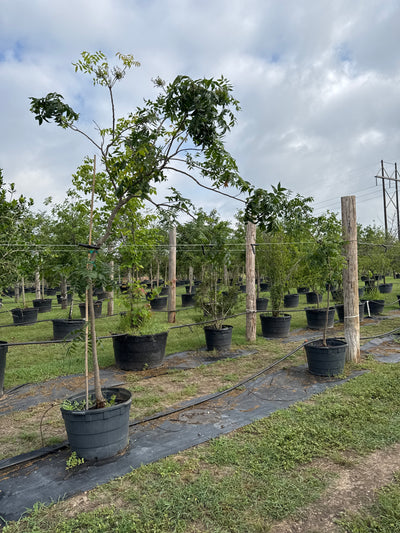


Avocado Hass


Avocado Hass
The Hass Avocado is the most widely cultivated avocado variety in the world. Originally discovered as a "chance seedling" in California, it has become the commercial gold standard due to its exceptional shelf life, high oil content, and durable skin. The tree features a spreading, rounded canopy with dense evergreen foliage. The Hass Avocado is recognizable by its thick, pebbly, and leathery skin. It is the only major variety that provides a built-in ripeness indicator, changing from forest green to dark purplish-black as it matures. The avocados are prized for their rich, nutty flavor and a very high oil content (up to 20%), which results in a dense, "butter-like" creamy texture. It offers an incredibly long harvest season, with fruit able to "hang" on the tree for 8 to 12 months without losing quality. In the garden, the Hass provides excellent shade and year-round greenery. In the kitchen, its durability makes it the preferred choice for shipping and retail, while its flavor makes it the premier choice for guacamole, slicing, and gourmet dishes.
| Scientific Name | Persea americana 'Hass' |
|
Foliage: Evergreen |
Leaves: Evergreen, glossy, and dark green. They are elliptical to lance-shaped, reaching 4–8 inches in length. They have a distinct "anise" scent when crushed. Flowers: Small, pale yellow-green clusters. It is a Type A pollinator (flowers open as female in the morning and male the following afternoon). Fruit: Medium to large with a distinct pebbly, thick, and leathery skin. The skin turns from green to a dark purplish-black when ripe. The flesh is rich, creamy, and high in oil. Seeds: Features a single, medium-sized, woody, and round-to-ovoid seed in the center. Bark: On young trees, the bark is smooth and green. As the tree matures, the bark becomes thick, grey-brown, and develops deep longitudinal fissures or furrows. |
| Life Span: Perennial | 50 to 200+ years (Productivity typically peaks between 20 and 40 years). |
| Mature Height | 25 to 35 feet (Though usually pruned to 15–20 feet for easier harvest). |
| Mature Width (Spread) | 15 to 25 feet (It has a more rounded, spreading canopy compared to the upright 'Bacon'). |
| Growth Rate | Moderate to Fast; can grow 2–3 feet per year in ideal conditions. |
| USDA Zone/Chill Hours | Zone 9 to 11 (Sensitive to frost; typically requires temperatures to stay above 28°F–30°F); Requires approximately 50 to 150 chill hours below 45°F to ensure a good bloom (Low-chill). |
PLANT CARE & CHARACTERISTICS
Light Requirements: Full Sun. Prefers 8–10 hours of direct sunlight. While it can tolerate very light shade, fruit production will be significantly reduced.
- Sunscald (Critical): The Hass has very sensitive bark. Because it is a spreading tree, removing a large upper branch can suddenly expose the "shoulders" of lower branches to intense sun. You must paint any newly exposed bark with a 50/50 mix of white interior latex paint and water.
Water Requirements: High & Frequent. Needs consistent moisture to support its high oil production. Young trees may need water every 2–3 days; mature trees require deep watering once a week (more in heat).
Drought Resistance: Low. Avocados have shallow, competitive roots that dry out quickly. Stress from drought often leads to fruit drop, leaf tip burn, and stunted growth.
Soil Type: Excellent Drainage is Mandatory. Prefers rich, loamy, or sandy soils. It absolutely cannot tolerate heavy clay or "wet feet," which leads to rapid root decline.
- Sensitive Roots: Unlike many fruit trees, avocados do not have "root hairs," making them less efficient at taking up water. They rely on a symbiotic relationship with fungi in the soil. Maintaining a thick mulch layer (using wood chips or fallen avocado leaves) is the best way to protect these delicate roots.
- Salt Sensitivity: Hass avocados are sensitive to salt buildup in the soil, which often manifests as "tip burn" (brown, crispy leaf ends). If you live in an area with salty water or high-mineral soil, you may need to "leach" the soil periodically by running water for an extended period to wash salts below the root zone.
Deer Resistance: Low. Deer find the tender, nutrient-rich new growth highly attractive. Protective fencing is usually necessary for young trees until the canopy is out of reach.
Pest/Disease Resistance: Low to Moderate. Highly susceptible to Phytophthora (Root Rot). Common pests include Persea mites, thrips, and avocado lace bugs, which can scar the fruit or damage leaves.
POLLINATION
The "Type A" Flowering Cycle. Avocados exhibit a behavior called protogynous dichogamy. This means the male and female parts of the same flower open at different times to prevent self-pollination.
- Day 1 (Morning): The flower opens as Female (receptive to pollen). It then closes in the afternoon.
- Day 2 (Afternoon): The same flower re-opens as Male (shedding pollen).
- Because the female stage (Morning, Day 1) and male stage (Afternoon, Day 2) do not overlap on the same tree, pollination can be tricky if the weather is perfectly consistent.
POLLINATION SUMMARY
| Feature | Details |
| Flowering Type | Type A |
| Primary Pollinator | Bees (Honeybees and Bumblebees) and Hoverflies. |
| Self-Fertility | Partial. While a single Hass tree can produce fruit (due to "leaky" flowering where some male/female stages overlap), the yield is often low or inconsistent. |
| Best Cross-Pollinator | Type B Varieties. To get a heavy crop, you need a Type B tree nearby whose male flowers open in the morning while the Hass female flowers are receptive. |
| Ideal Partners | 'Bacon', Zutano, or Fuerte. |
HARVEST
Typically Spring through Fall (February to October in many regions). The avocados do not ripen on the tree. They only begin to soften once they are clipped from the branch.
How to Determine if Your Avocados Are Ready to Harvest
Because Hass avocados stay on the tree for 12–14 months, it’s common to have "new" small fruit and "old" large fruit on the tree at the same time.
1. Visual Indicator: The skin changes from bright green to a dark purplish-black. This is the most reliable visual cue for the Hass.
2. Texture Indicator: The "Pebbly" skin will lose its tight sheen and become slightly more matte as it reaches maturity.
3. Touch: Apply gentle pressure at the stem end (the "neck"). If it yields slightly, it is ready. If it feels "mushy," it is likely over-ripe.
4. The Size Check: Wait until the fruit reaches its "standard" size (usually 6–10 ounces).
5. The Sample Test: Pick one large, dark-colored avocado and leave it on your kitchen counter.
- If it ripens within 7–10 days without shriveling, the rest of the crop is ready to start harvesting.
- If it shrivels or stays rubbery, the oil content isn't high enough yet; wait another 3–4 weeks before trying again.
Harvesting Techniques
1. The "Button" Method: When picking, use hand pruners to clip the stem about 1/4 inch above the fruit. Do not pull the fruit off the tree, as this can tear the "button" (the stem attachment) and lead to rot at the top of the avocado.
2. The Pole Picker: Because Hass trees can get quite tall, a fruit-picking pole with a basket and a "finger" clipper is essential to reach the highest, often largest, fruit without a ladder.
3. Selective Harvesting: Always harvest the largest fruit from the top and outside of the canopy first. This lightens the load on the branches and allows the smaller, interior fruit more light and energy to grow.
YIELD
| Tree Status | Fruit Count | Development Focus |
| Root Establishment: Years 1-2 | 0 Fruit | Critical Stage. Remove any "pioneer" fruit. The Hass is prone to "runt out" if it fruits too early, stalling its structural growth. |
| Initial Production: Year 3 | 5 – 15 Fruit | The first taste of the crop. Fruit is often concentrated on the inner branches where it is shaded from the sun. |
| Expanding Canopy: Year 4 | 40 – 80 Fruit | The tree begins its "spreading" phase. Branches may require staking to prevent snapping under the weight of the heavy Hass fruit. |
| Early Maturity: Years 5-7 | 100 – 200 Fruit | The tree enters a reliable production phase. At this point, the tree is typically yielding 60–100 lbs of fruit. |
| Full Maturity: Year 10+ | 300 – 500+ Fruit | A fully mature, healthy Hass can produce between 200 and 350 lbs annually if pollination is optimized with a Type B partner. |
Key Biological Factors Affecting Hass Yield
1. Alternate Bearing (The "On/Off" Cycle): Hass trees are famous for alternate bearing. A massive "On" year (where the tree is loaded with fruit) is often followed by an "Off" year (very little fruit). This happens because the tree exhausts its carbohydrate reserves.
- Management: To stabilize yield, thin out some fruit during a heavy "On" year to preserve the tree's energy for next year's flower buds.
2. The "Spring Flush" vs. Fruit Set: In the spring, the Hass tree tries to grow new leaves and flowers simultaneously. If the tree is stressed by heat or lack of water, it will prioritize the leaves and drop the flowers or "BB-sized" fruit.
3. Yield Efficiency by Training Style
- Standard Spacing: Trees are allowed to reach 25+ feet. Yield is high per tree but harder to harvest.
- High-Density Planting: Trees are kept pruned to 10–12 feet and planted closer together. This results in lower yield per tree but much higher yield per square foot of your orchard, as the fruit is easier to manage and protected from wind.
STORAGE/SHELF LIFE
| Stage | Storage Method | Shelf Life |
| Unripe (Hard/Green) | Room Temperature (Countertop) | 4 to 7 days |
| Unripe (Hard/Green) | Refrigerator (Crisper Drawer) | Up to 2 weeks (Cold "pauses" the ripening process). |
| Ripe (Soft/Black) | Room Temperature (Countertop) | 2 to 3 days |
| Ripe (Soft/Black) | Refrigerator (Airtight container) | 3 to 5 days |
| Cut (Open Fruit) |
Refrigerator (Wrapped & |
1 to 2 days (Oxidation begins immediately) |
Optimizing Your Hass Harvest
1. The Ripening "Trigger": Hass avocados only begin to ripen once they are removed from the tree.
- To Speed Up: Place hard fruit in a brown paper bag with a banana or apple. The ethylene gas will accelerate ripening, usually within 24–48 hours.
- To Delay: If you have a large harvest, keep the bulk of the fruit in the refrigerator immediately after picking. Take out only 3 or 4 at a time to ripen on the counter as needed.
2. Preserving Cut Fruit: The high fat content in Hass makes it oxidize (turn brown) when exposed to oxygen. To keep a cut half fresh:
- Keep the Pit: Leaving the seed in the half you aren't using reduces the surface area exposed to air.
- Acid Barrier: Brush the flesh with lime juice, lemon juice, or even a light coating of olive oil.
- Contact Wrap: Press plastic wrap directly against the flesh so there are no air bubbles.
3. Long-Term Freezing: If you have a surplus that you cannot eat within a week:
- Puree: Mash the ripe Hass flesh with 1 tablespoon of lemon or lime juice per avocado.
- Seal: Place in a vacuum-sealed bag or a freezer-safe container with minimal headspace.
- Duration: It will stay flavorful for 4 to 6 months. This is ideal for guacamole or smoothies, though the texture will be too soft for slicing once thawed.
PRUNING
1. Structural Training (Early Years)
- Encouraging a Strong Frame: Unlike the Bacon, you rarely need to "top" a Hass to get it to branch; it does so naturally. Instead, focus on removing "low-angle" branches that are too horizontal, as these can snap under the weight of a heavy Hass crop.
- The "Central Leader" Choice: Some growers prefer a single trunk, while others allow 3–4 main "scaffold" branches. In home gardens, a multi-main-branch approach (shaped like a vase) is often better to keep the tree lower and wider.
2. Canopy Management (The "Open Center" Strategy): The Hass produces a very thick leaf canopy. This can shade out the interior of the tree, causing the inner branches to become "blind" (stop producing fruit).
- Thinning for Light: Every year, remove a few "water sprouts" (fast-growing vertical shoots) from the center. This allows sunlight to reach the inner branches and the ground around the trunk.
- Airflow: Keeping the center somewhat open reduces humidity within the foliage, which is your best defense against Anthracnose and other fungal diseases common to the Hass variety.
3. Size Control (The "Maintenance" Phase): Because Hass avocados can reach 35 feet, most home growers use Size Control Pruning to keep them at 10–15 feet.
- Heading Back: Cut the tallest branches back to a strong lateral (side) branch.
- Width Control: If the tree is spreading too wide into walkways or other plants, prune the lateral branches back to a "heading" cut to encourage a more compact shape.
4. Skirt Raising
- The 2-Foot Rule: Prune all lower branches so the "skirt" of the tree is at least 2 feet off the ground.
- Why? Hass fruit often hangs low. If branches touch the ground, it creates a "bridge" for ants and snails to reach the fruit and increases the risk of soil-borne fungi splashing onto the leaves during rain.
5. Important Hass-Specific Precautions
- Pruning Window: The best time to prune is late winter or early spring, just before the spring growth flush.
- Avoid "Pruning the Crop": Since Hass fruit can stay on the tree for 12 months, you will often have mature fruit on the tree when it's time to prune. Be careful not to cut off branches loaded with the current year's harvest!
- Cleanliness: Hass is sensitive to viruses. Sterilize your pruning saws and shears with isopropyl alcohol between every tree to prevent the spread of disease.
PRUNING SUMMARY
| Pruning Type/Timing | Technique | Primary Purpose |
| Structural Training: Years 1-3 | Select 3–4 strong scaffold branches; remove weak, low-angle limbs. | Builds a strong "vase" shape to support heavy fruit weight. |
| Open Center Thinning: Annually | Remove 1–2 large vertical "water sprouts" from the center. | Allows sunlight and air to reach the inner branches to prevent die-back. |
| Height Management: Late Winter | Head back the tallest limbs to a strong lateral (side) branch. | Keeps the tree at a manageable 10–15 feet for easy harvesting. |
| Skirt Raising: Anytime | Prune all branches so they sit at least 2 feet above the soil. | Prevents ants/snails from climbing and stops soil-borne fungal splash. |
| Window Pruning: Post-Harvest | Cut small "windows" into dense patches of foliage. | Increases light penetration to encourage fruit set in the interior. |
| DDD Maintenance: Immediately | Cut out Dead, Diseased, or Damaged wood. | Prevents the spread of pathogens like Anthracnose or Botryosphaeria. |