


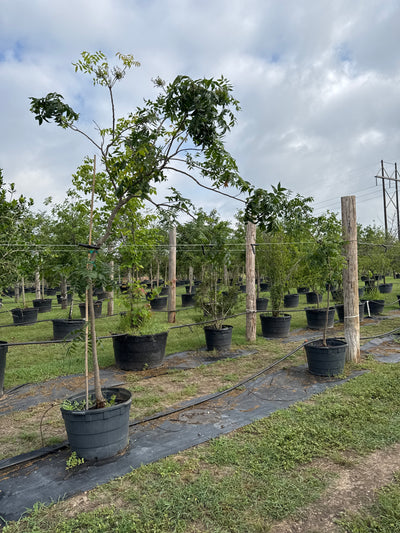


Ash Green


Ash Green
Location on Farm:
🌱 Planting Installation
| Scientific Name | Fraxinus pennsylvanica |
|
Foliage: Deciduous |
Leaves: Pinnately compound, typically featuring 5 to 9 leaflets (most commonly 7). The leaflets are lance-shaped, finely toothed along the margins, and medium-to-dark green in the summer, turning a vibrant, distinct ash-green to bright yellow in the autumn. Flowers: Inconspicuous, small, and petal-less. They appear in compact clusters (panicles) in early spring before the leaves emerge. Green Ash is dioecious, meaning male and female flowers grow on separate trees; female flowers give way to drooping clusters of winged seeds (samaras). Seeds (Samaras): Single, plump, cylindrical seed cavity at one end, which seamlessly tapers into a long, flat, paper-like wing. The seeds grow in dense, heavy, drooping clusters that start out a light green or yellowish-green color. By late autumn (September to November), they dry out completely, turning a uniform tan, pale brown, or straw color as they ripen. Bark: Smooth and gray-brown on young trees, developing a highly distinct, tight network of interlocking, diamond-shaped ridges and deep furrows as the tree matures. |
| Life Span: Perennial | Typically 100 to 125 years in optimal wild conditions, though urban lifespans are often significantly shorter (30 to 50 years), especially when impacted by pests. |
| Mature Height | 50 to 70 feet |
| Mature Width (Spread) | 35 to 50 feet |
| Growth Rate | Fast; routinely grows 1.5 to 2.5 feet per year under proper conditions, making it a historic favorite for quick shade. |
| USDA Zone | Zone 3 through 9 (Extremely hardy and adaptable to a wide range of climates and soil types). |
PLANT CARE & CHARACTERISTICS
Light Requirements: Full Sun (Requires at least 6 hours of direct, unfiltered sunlight daily for optimal growth and canopy density). It is highly shade-intolerant.
Water Requirements: Moderate to High; prefers moist, well-drained soils and handles occasional flooding exceptionally well (often found in river bottoms naturally). However, it establishes a deep root system that allows it to survive extended dry periods once mature.
Drought Resistance: High (Once Established). While it thrives with regular moisture, it is remarkably resilient against drought and heat compared to many other large shade trees.
Soil Type: Highly Adaptable. It tolerates a massive range of soils, including heavy clay, compacted urban dirt, alkaline (high pH) soils, and wet, poorly drained sites. It performs best in rich, moist loams.
Deer Resistance: Moderate. Mature trees are rarely bothered by deer, but young saplings have tender twigs and foliage that deer will browse. Young trunks are also susceptible to buck rubbing in the fall, so tree guards are recommended for new plantings.
Pest/Disease Resistance: Low. It is highly vulnerable to the Emerald Ash Borer (EAB), an invasive beetle that is fatal to unprotected ash trees. It is also susceptible to ash yellows (a phytoplasma disease), anthracnose (fungal leaf spot), and clearwing borers if the tree is stressed.
Pollination: Wind-Pollinated. As a dioecious species, male trees release abundant pollen into the wind in early spring to fertilize the female trees. The female trees then produce the iconic single-winged, paddle-shaped seeds (samaras).
PRUNING
Best Time to Prune: Late Winter to Very Early Spring (Dormant Season). Pruning just before the buds break is ideal. The tree is dormant, making it easy to see the structural branch architecture without leaves in the way. It also gives the tree a full growing season ahead to seal over the wounds.
Avoid Pruning: Late Spring and Summer. Open pruning wounds during the active growing season emit volatile organic compounds (chemical scents) that can attract wood-boring insects—including the highly destructive Emerald Ash Borer (EAB) and clearwing borers.
Pruning Step-by-Step
Because Green Ash trees have an opposite branching pattern (buds and branches grow directly across from one another in pairs, rather than alternating), they are highly prone to forming competing, tight "V-shaped" forks. Use this sequence to establish a clean, strong structure.
1.Clean the Canvas (The 3 Ds): First priority.Always start by removing any branches that are Dead, Damaged, or Diseased. Cut these back to healthy wood or completely remove them at the branch collar.
2. Establish a Single Leader: Critical for young trees.Green Ash trees love to develop "co-dominant leaders"—two main upright trunks competing for dominance. Pick the strongest, straightest vertical shoot to be the main trunk, and prune out or heavily suppress its competitor. A single leader prevents the tree from splitting down the middle during heavy storms later in life.
3. Eliminate Weak Crotches: Structural stability.Look for branches that meet the main trunk at sharp, narrow angles (less than 45 degrees). These narrow unions often develop included bark (bark pinched inside the joint), making them incredibly weak. Retain branches with wide, strong "U-shaped" attachment angles (45 to 60+ degrees).
4. Thin the Interior: Airflow and light.Because branches grow directly opposite each other, the canopy can become intensely crowded. Remove one side of an opposite pair if they are cluttering the interior. Prune out branches that cross over, rub against one another, or grow directly back inward toward the center of the tree.
5. Raise the Canopy (Limbing Up): Over multiple seasons.If the tree is near a walkway, driveway, or lawn, gradually remove the lowest branches over a few years to provide clearance. Avoid stripping the lower half of the tree all at once; keep at least the top two-thirds of the tree's total height full of living branches to maintain its energy reserves.
3 Golden Rules for Ash Trees
1. The 25% Rule: Never remove more than 20-25% of the total living canopy in a single year. Over-pruning stresses the tree, triggering a massive flush of weak, vertical "water sprouts" (suckers) and lowering its natural resistance to pests.
2. Never Cut the Branch Collar: When removing a limb, look for the swollen collar where the branch meets the trunk. Cut just outside this wrinkled ridge. Do not make a flush cut flat against the trunk, as this destroys the tree's internal defense zone and prevents it from healing.
3. Sanitize Your Tools: Ash trees are susceptible to fungal cankers and anthracnose. Wipe your pruning saw or loppers down with a 70% isopropyl alcohol solution or a 10% bleach solution between cuts if you are removing diseased wood, and always sanitize between different trees.