


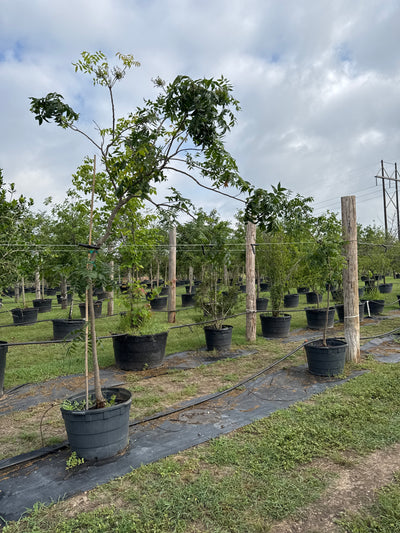


Apple Dorsett Golden


Apple Dorsett Golden
🌱 Planting Installation
The Dorsett Golden Apple (often spelled "Dorset") is a superstar for warm-climate gardeners. While most apple trees need a long, cold winter to wake up and produce fruit, this variety was discovered in the Bahamas and is famous for its extremely low "chill" requirement. The tree produces medium to large apples with smooth, golden-yellow skin. The flesh is white, crisp, and sweet with a flavor profile similar to 'Golden Delicious' but with a hint of vanilla.
| Scientific Name | Malus domestica 'Dorsett Golden’ |
| Foliage: Deciduous |
Leaves: Oval to elliptic, serrated edges, medium–dark green in season (typical apple foliage). Flowers: Pink-tinged white blossoms in spring; in very mild-winter climates it can bloom very early (often Jan–Feb). Fruit: Medium to large, golden-yellow skin often with a pink/orange-red blush; flesh described as firm, crisp, sweet (Golden Delicious-type). Seeds: Typical apple seeds; small, teardrop-shaped, dark brown when mature. Bark: Typical apple bark; gray-brown, becomes rough/scaly with age (lenticels common). |
| Lifespan: Perennial |
Dwarf: 15 to 25 years Semi-Dwarf: 20 to 35 years Standard: 35 to 50+ years |
| Mature Height |
Dwarf: 8 to 10 feet Semi-Dwarf: 12 to 15 feet Standard: 20 to 25 feet |
| Mature Width (Spread) | Generally equal to the height (8-25 feet depending on rootstock). |
| Growth Rate | Moderate to Fast |
| USDA Zone/Chill Hours | Zone 5-9 (Highly recommended for the Deep South and Southern California); Requires 100-300 chill hours (one of the lowest requirements of any apple variety) |
PLANT CARE & CHARACTERISTICS
Light Requirements: Full sun; (At least 6-8 hours of direct sunlight daily).
Water Requirements: Moderate; prefers consistent moisture, especially when fruit is first setting. If you are facing a prolonged dry spell, follow these guidelines to keep your Dorsett Golden healthy:
| Tree Age | Watering Frequency in Drought | Why? |
| Young (1-2 years) | 2–3 times per week | Essential for root development and survival. |
| Established (3+ years) | Deep soak every 10–14 days | Encourages roots to stay deep where the soil is cooler. |
| Fruiting Season | Weekly deep watering | Drought during fruit swell (May–June) results in small, dry apples. |
Drought Resistance: Moderate. Once established (usually after 2–3 years), the tree can withstand short dry periods, but it is not a "desert plant." During the first two years, the tree has low drought tolerance. It needs consistent moisture to build the deep root system required for future resilience. In extreme heat (95°F+), the tree may "flag" or wilt slightly during the day even if the soil is damp. This is a defense mechanism to prevent water loss through the leaves. If it doesn't perk up by morning, it's a sign of true drought stress.
Soil Type: Well Drained, loamy soil; pH 6.0-7.0 (Slightly Acidic to neutral). If you live in a dry climate it is recommended to apply a 3-inch layer of organic mulch (wood chips or straw) around the base, keeping it a few inches away from the trunk. This can reduce water evaporation by up to 50%.
Deer Resistance: Low. Like most fruit trees, deer find the leaves and fruit very attractive. Fencing is recommended if deer are present.
Pest/Disease Resistance: High resistance to Apple Scab and moderate resistance to Fire Blight and Powdery Mildew. It is considered a relatively low-maintenance variety.
Pollination: Partially self-fertile. While it can produce fruit alone, you will get a significantly larger and better-quality crop if planted with a partner like the 'Anna' apple, which shares its low-chill bloom time.
Harvest: Early Summer (Late June to July). It is often one of the first apples to ripen in the season. Because it is a "low-chill" variety designed for warmer climates, it tends to wake up and get to work much faster than a standard 'Gala'.
HARVEST TIMELINE
| Year 1 | Establishing roots. (Remove any fruit that forms to avoid "stunting". |
| Year 2 | You may see your first "tester" crop of 5-10 lbs (for a dwarf tree) |
| Years 3-5 | The tree enters "early production," yielding roughly 30-75 lbs (for a semi-dwarf tree) |
| Year 6+ | The tree is considered fully mature and will hit its peak yield (for a standard tree) |
The "First Year" Rule: Just like with the Gala, if your Dorsett Golden produces fruit in its very first year in the ground, it is best to remove the tiny apples. Dorsett Golden is such a heavy producer that a young tree can literally snap its own branches under the weight of the fruit before the wood is strong enough to support it.
How to Know if Your Dorsett Golden Apple Tree is Ready to Harvest
1. Color Shift: The skin will turn from a "granny smith" green to a clear, golden yellow. If it has a pink blush, that blush will become more vibrant.
2. The "Lift" Test: Cup the apple in your hand and give it a slight upward twist. If it’s ripe, the stem will snap cleanly away from the branch (this is called "abscission"). If you have to yank it, it's not ready.
3. The Seed Test: Slice one open. If the seeds are dark brown, the apple is mature. If they are still white or tan, give the rest of the tree another week.
A Unique "Bonus" Harvest: In tropical or subtropical climates (like Southern California or Florida), the Dorsett Golden is famous for occasionally blooming twice. You might get a main harvest in mid-summer and a smaller "sneaky" harvest in late autumn!
YIELD
| Tree Type | Mature Height | Annual Yield (lb) | Yield in "Bushels" |
| Dwarf | 6–8 ft | 30 – 60 lb | ~1 to 1.5 bushels |
| Semi-Dwarf | 12–15 ft | 100 – 250 lb | ~2 to 6 bushels |
| Standard | 20+ ft | 300 – 500+ lb | ~7 to 12+ bushels |
STORAGE/SHELF LIFE
The Dorsett Golden is a "short-term" apple. Unlike late-season varieties (like the 'Arkansas Black') that are built for months of storage, the Dorsett Golden is a summer apple. It is prized for its immediate sweetness and crispness, but those qualities fade quickly after it leaves the tree. Because this variety ripens in the heat of early summer (June–July), it lacks the thick, waxy "armor" of winter apples.
| STORAGE METHOD | SHELF LIFE | NOTES |
| Countertop (Room Temp) | 3-5 days | In a warm kitchen, the flesh will quickly become soft and mealy. |
| Refrigerator (32°F to 38°F) | 2-3 weeks | While some sources suggest it can stretch to 6 weeks under perfect industrial cooling, for the home gardener, the flavor and "crunch" peak within in the first 14 days. |
| Root Cellar | Not recommended | Summer temperatures are usually too high for cellar storage to be effective for this variety. |
Maximize Your Freshness
1. Harvest Early: If you plan to store them, pick the apples when they are 90% yellow (still showing a hint of green). They will finish ripening in the fridge and stay crisp longer than those picked at full "gold" maturity.
2. Cold Chain: Get the apples from the tree to the refrigerator as fast as possible. Every hour an apple sits in the summer sun after being picked reduces its shelf life by roughly one day.
3. Humidity: Store them in a perforated plastic bag or the crisper drawer with a slightly damp paper towel. This prevents the thin skin from shriveling.
Best Uses for "Over-Ripe" Dorsett Goldens
If you find a batch has gone soft in the fridge, don't toss them! Because they are naturally very sweet and low in acid:
- Applesauce: They break down beautifully and require almost no added sugar.
- Apple Butter: Their high sugar content caramelizes quickly.
- Juicing: They produce a very clear, honey-like juice.
PRUNING
1. Timing: The Early-Bird Window
- Primary Pruning (Late December – January): You must finish your structural pruning before the buds begin to swell. In Southern California, Arizona, or Florida, this window is much earlier than for traditional apples.
- Summer Pruning (July – August): Dorsett Goldens are notorious for sending up "water sprouts" (long, vertical, whip-like branches) after the summer harvest. Snip these off in late summer to keep the tree’s energy focused on next year’s fruit buds rather than useless vertical wood.
2. The Strategy: "Open Center" vs. "Modified Leader"- Most home growers prefer the Open Center (Vase) shape for Dorsett Golden.
- The Goal: Remove the central "trunk" after the tree reaches about 3–4 feet, allowing 3–5 main branches to grow outward like a bowl.
- Why? This maximizes sunlight to the center of the tree. Since Dorsett Golden fruit develops a better "pink blush" and higher sugar content with direct sun, an open canopy is essential.
3. Structural Priorities
- Heading Back: Dorsett Golden has a "weeping" tendency when loaded with fruit. Cut the tips of long, thin branches back by about 20% to an outward-facing bud. This "stiffens" the branch so it can support heavy apples without snapping.
- Widening Angles: The tree naturally wants to grow narrow and upright. Use branch spreaders (small sticks) to push young branches out to a 45-60° angle. Horizontal branches produce more fruit; vertical branches produce only leaves.
- The 3 D's: As always, start by removing Dead, Damaged, and Diseased wood. Dorsett Golden is fairly resistant to Fire Blight, but always prune out any blackened "shepherd's crook" tips immediately.
4. Protecting the Fruit Spurs: Like many traditional apples, the Dorsett Golden is a spur-bearer.
- Look for the small, stubby, wrinkled "spurs" along the main branches. Do not prune these off. This is where the flowers and fruit will form for the next 10+ years.
- Only thin out spurs if they become so crowded (closer than 4 inches) that the apples will rub against each other.
5. The "Golden" Rule: Fruit Thinning: This is technically "pruning the crop," and it is the most important step for a Dorsett Golden.
- The Problem: This tree is too productive. It will try to grow clusters of 6–8 apples.
- The Fix: In late spring (April/May), thin each cluster down to one single apple.
- The Result: If you don't thin, you'll get a "bumper crop" of tiny, tasteless apples one year and zero apples the next (biennial bearing). Thinning ensures large, sweet fruit every single year.


