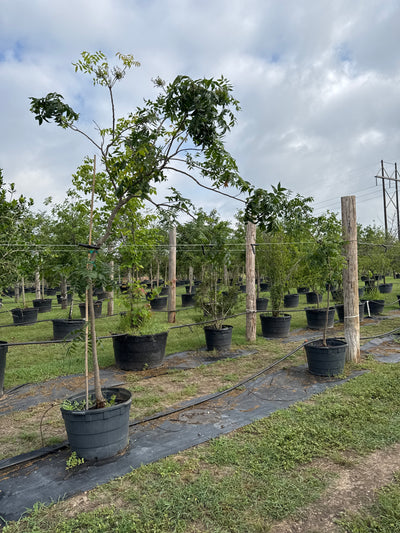
The Muskogee Crape Myrtle is a legendary hybrid from the U.S. National Arboretum, famous for being one of the largest and longest-blooming varieties available. It is often used to create a "canopy" effect due to its impressive height. The Muskogee Crape Myrtle is a deciduous tree prized for its profusion of large, lavender-pink flowers that bloom in summer. The flowers are borne in panicles at the tips of branches and are known for their delicate color and long-lasting display. The foliage is dark green in color and turns shades of orange, red, and yellow in the fall before dropping. In addition to its flowers, the Muskogee Crape Myrtle is also valued for its attractive exfoliating bark, which peels away to reveal smooth, cinnamon-colored bark underneath. The Muskogee Crape Myrtle is the perfect "shade tree" version of a Crape Myrtle. Because of its massive size, it is best used as a standalone specimen or to line long driveways where it has plenty of room to spread its wings.
|
Scientific Name
|
Lagerstroemia x 'Muskogee' |
|
Foliage: Deciduous
|
Leaves: The leaves are a thick, lustrous dark green. Muskogee is highly prized for its autumn display, where the foliage transforms into a vivid reddish-orange.
Flowers: Masses of light lavender to orchid-pink blooms. It has a remarkably long blooming season, often lasting up to 120 days (mid-summer through fall).
Bark: Beautiful cinnamon-to-gray exfoliating bark. As it matures into a large tree, the smooth, muscular trunk becomes a major landscape feature.
Seeds: Small, round woody capsules that persist into winter, providing subtle texture to the bare winter branches.
|
|
Mature Height
|
20–30 feet (one of the tallest varieties) |
|
Mature Width (Spread)
|
15–25 feet (wide, spreading canopy) |
|
Growth Rate
|
Fast (often more than 3 feet per year once established) |
|
USDA Zone
|
6-9 |
Plant Care & Characteristics
Light Requirements: Full Sun (6+ hours). Necessary for peak flowering and mildew prevention.
Water Requirements: Moderate. Needs regular deep watering during its first two summers.
Drought Resistance: High. Once established, it is remarkably drought-tolerant.
Soil Type: Adaptable. Prefers well-drained soil with good fertility and adequate moisture retention. They are adaptable to a variety of soil types, including sandy, loamy, or clay soils, as long as they are well-drained. Amending the soil with organic matter such as compost or peat moss before planting can improve soil structure and provide essential nutrients for healthy growth. Mulching around the base of the plant helps retain soil moisture, suppress weeds, and protect the shallow roots.
Deer Resistance: High. Generally avoided by deer.
Maintenance: Muskogee Crape Myrtles are relatively low-maintenance once established but benefit from regular care to ensure healthy growth and abundant flowering. Prune as needed to remove dead, diseased, or overgrown branches and to maintain the desired shape and size. Light pruning can be done throughout the growing season, while more extensive pruning is typically done in late winter or early spring before new growth emerges.