


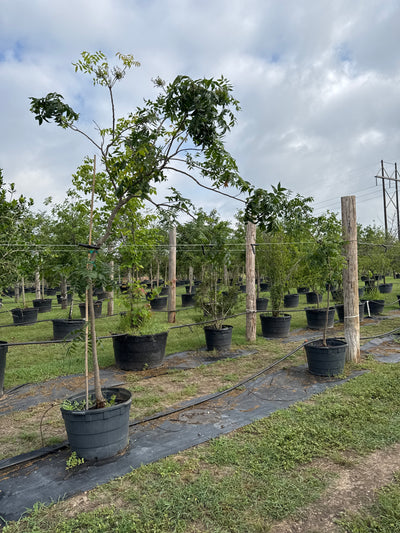


Fig Brown Turkey


Fig Brown Turkey
Use collapsible tabs for more detailed information that will help customers make a purchasing decision.
Ex: Shipping and return policies, size guides, and other common questions.
The Brown Turkey Fig is a deciduous shrub or small tree with large, lobed leaves that are dark green and slightly hairy on the upper surface and lighter green underneath. It produces medium to large-sized figs with a purplish-brown skin and sweet, reddish-pink flesh. The Brown Turkey Fig is often called the "Reliable Fig" because it is a prolific producer that begins fruiting at a very young age. Like the Black Mission, it is a bifere variety, meaning it can provide two distinct harvests in a single growing season.
| Scientific Name | Ficus carica 'Brown Turkey' |
|
Foliage: Deciduous |
Leaves: Large and deeply lobed. Typically features 3 to 5 lobes. They are a vibrant dark green with a slightly "fuzzy" or pubescent underside and a rough top. Flowers: Internal (Syconium). Like all figs, the flowers are hidden inside the developing fruit. You will never see a traditional "bloom" on the branches. Fruit: Medium to large, pear-shaped. The skin is a brownish-copper to mahogany color with hints of purple. The flesh is a pale pink to amber-rosy hue. Seeds: Small and crunchy. The interior is filled with tiny edible seeds (achenes) that give the fruit its signature texture. Bark: Smooth and light gray. As the tree ages, the bark remains relatively smooth but can develop slight fissures and a "muscular" knotted appearance. |
| Life Span: Perennial | A Brown Turkey fig tree has a typical lifespan of 50 to 100 years when grown in optimal conditions. |
| Mature Height | 10 – 20 feet (Easily pruned to a 6–8 foot bush). |
| Mature Width (Spread) | 10 – 20 feet (Often wider than it is tall if not headed back). |
| Growth Rate | Fast. Can put on 3+ feet of new growth in a single season. |
| USDA Zone/Chill Hours | Zone 7 – 11 (Root hardy to Zone 6 with heavy winter mulching). Requires 100 or fewer chill hours. (Very low-chill requirement, similar to the 'Black Mission'). |
PLANT CARE & CHARACTERISTICS
Light Requirements: Full Sun. It needs at least 8 hours of direct sunlight to develop the sugars (Brix) in the fruit.
Water Requirements: Moderate. Requires deep, consistent watering during the fruit-swell period. Inconsistent moisture can cause the fruit to split.
Drought Resistance: High (Once Established). While the tree survives drought well, it will often drop its fruit to conserve energy if water is scarce.
Soil Type: Well-Drained Loam. Prefers a pH of 6.0–6.5. It is highly adaptable but sensitive to "wet feet" (root rot).Figs have aggressive, shallow feeder roots.
- Mulching: Apply a thick (3-4 inch) layer of wood chips or straw around the base (but not touching the trunk). This keeps the roots cool and prevents the "surface drying" that causes fruit drop.
- Fertilization: Avoid high-nitrogen fertilizers once the tree is established. Too much nitrogen encourages massive leaf growth at the expense of fruit production.
Deer Resistance: Moderate. The milky white latex sap in the leaves and stems is usually unpalatable to deer, though they may eat the sweet ripening fruit.
Pest/Disease Resistance: Moderate. Generally hardy. Main concerns are Fig Rust (foliage fungus) in humid climates and Birds or Wasps during the harvest.
- Bird Netting: If you notice birds pecking the fruit just as it turns brown, lightweight bird netting is the most effective solution.
- Organza Bags: For the highest quality "table fruit," some growers tie small mesh organza bags around individual figs to protect them from wasps and beetles
Pollination: Self-Fertile. Does not require a second tree or the fig wasp to set fruit.
Harvest: Double Crop. A small Breba crop in early summer (June) and a heavy Main crop in late summer/fall (August–October).
- Brown Turkey figs are ready to harvest when the fruit changes from green to a brownish-copper and the neck of the fruit wilts, causing the fig to hang vertically.
- Pro Tip: If the fruit is still horizontal or "reaching" out from the branch, it isn't ready. Unlike many other fruits, figs do not continue to ripen or sweeten once they are removed from the tree.
YIELD
| TREE AGE | YIELD | NOTES |
| Year 1–2 | 1 – 5 lbs | Early Starter. Brown Turkeys often produce fruit in their first year in the ground, though yields are light. |
| Year 3–5 | 20 – 50 lbs | Adolescence. The tree establishes its "Main" crop on new wood. Yields increase rapidly. |
| Year 6–10 | 60 – 150 lbs | Young Maturity. Expect a consistent early "Breba" crop followed by a heavy late-summer harvest. |
| Year 15+ | 150 – 300+ lbs | Peak Maturity. In ideal conditions (Zones 8–9), a mature tree can produce a massive volume of fruit. |
STORAGE/SHELF LIFE
| STORAGE METHOD |
SHELF LIFE | NOTES |
| Countertop | 1 – 2 Days | Best if eaten immediately. Keep in a cool, shaded area. Do not wash until ready to eat. |
| Refrigerator | 3 – 7 Days | Store in a single layer on a plate lined with paper towels. The Brown Turkey holds up slightly longer in cold storage than the Black Mission. |
| Freezer | 8 – 12 Months | Flash freeze whole figs on a tray before bagging. They maintain their sweetness well but will be soft upon thawing. |
| Dried | 12 – 18 Months | While excellent for drying, they are slightly less "jammy" than Black Missions, resulting in a chewier, sugar-focused dried fruit. |
Critical Harvesting & Storage Insights
1. The "Neck" Droop: Harvest when the fruit changes from green to a brownish-copper and the "neck" of the fig wilts, causing the fruit to hang vertically. If the fig is still pointing outward or feels firm, the sugars haven't fully developed.
2. The Closed Eye Advantage: Brown Turkey has a relatively "closed eye" (the small hole at the bottom). This protects the interior from "souring" (fermentation caused by insects or rain), which slightly extends its shelf life on the tree compared to "open-eye" varieties.
3. Handle with Care: Even with its slightly tougher skin, the fruit is prone to bruising. Use shallow picking baskets to prevent the weight of the top figs from crushing those at the bottom.
4. Preservation Tip: Because Brown Turkeys hold their shape well, they are the preferred variety for whole-fruit preserves or canning in syrup.
5. Identifying Spoilage
- Fermentation: If the fruit feels "puffy" or smells like alcohol/vinegar, the internal sugars have begun to ferment.
- Skin Integrity: Look for "weeping" at the eye or dark, water-soaked spots on the skin. This indicates the fruit is beginning to break down and should be processed or eaten immediately.
PRUNING
Pruning a Brown Turkey Fig is generally straightforward because this variety is incredibly resilient. It is known for its ability to produce fruit even if it is cut back heavily or suffers from winter dieback, as it fruits reliably on "new wood" produced during the current growing season.
Two Common Shaping Methods
1. The Low-Branching Bush (Recommended for Zone 7)- In regions where winter temperatures might dip low enough to kill branches, a bush shape is safest.
- The Technique: Allow 3 to 5 main stems to grow from the ground.
- Annual Maintenance: Every winter, remove about one-third of the oldest, tallest stems. This keeps the tree "renewing" itself with vigorous new wood that produces the heaviest fruit.
2. The Standard Tree (Recommended for Zones 8–11)- In warmer climates, you can train the Brown Turkey into a traditional tree shape with a single trunk.
- The Technique: Prune away all low-growing suckers and side branches until the "trunk" is about 3 feet tall.
- The Canopy: Create an "open center" (vase shape) by removing branches that grow toward the middle. This ensures sunlight reaches the interior fruit, which is essential for sweetening Brown Turkeys.
Strategic "Crop Balancing"
The Brown Turkey produces a Breba crop (early summer fruit on last year's wood) and a Main crop (late summer fruit on new growth).
- For a Bigger Fall Harvest: Prune the previous year's branches back by about half in late winter. This stimulates a massive flush of new green growth, where the heavy "Main crop" develops.
- For a Bigger Spring Harvest: Be conservative. Leave the tips of last year's branches intact, as that is where the early "Breba" figs are currently waiting to grow.
Important Pruning Tips
1. Sanitize Your Tools: Fig trees can be susceptible to fungal issues if cut with dirty blades. Clean your loppers or hand pruners with rubbing alcohol between trees.
2. Watch the Sap: Like all figs, the Brown Turkey contains a milky white latex sap. This can cause skin irritation, especially when exposed to sunlight (phototoxicity). Always wear gloves and long sleeves when pruning.
3. Thinning vs. Heading: If the tree is too dense, use "thinning cuts" (removing a branch entirely at its base) rather than "heading cuts" (cutting off just the tip). Thinning improves airflow and reduces the risk of Fig Rust.
4. The "Pinch" Trick: In mid-summer, once a new branch has 5 or 6 leaves, pinch off the very tip (the terminal bud). This stops the branch from getting longer and forces the tree to send its sugar and energy into the figs already growing on that branch.
PRUNING SCHEDULE
| Pruning Type | Timing | Purpose |
| Initial Training | Late Winter (Year 1–2) | Establishing the main framework (either a central trunk or a multi-stem bush). |
| Dormant Pruning | Late Winter / Early Spring | The main annual pruning. Performed while the tree is "asleep" and before the sap begins to flow. |
| Maintenance | Anytime | Immediate removal of the "3 Ds": Dead, Damaged, or Diseased wood. |
| Summer Pinching | June / July | Cutting the tips of new green shoots to encourage the fruit to ripen faster. |


