


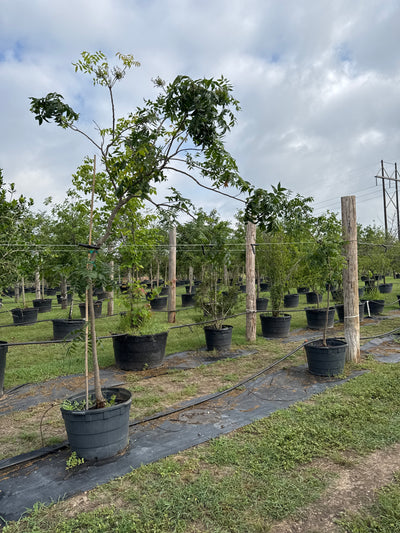


Chinese Pistache


Chinese Pistache
Location on Farm:
🌱 Planting Installation
The Chinese Pistache is a tough, medium-sized deciduous shade tree widely praised by urban foresters as one of the most resilient and beautiful landscape trees available. It features dark green, feather-like compound leaves that remain lush through the summer heat. In autumn, it steals the show, transforming into a spectacular, luminous canopy of vibrant orange, glowing yellow, and fiery scarlet red—offering some of the most reliable fall color available, even in warm southern climates. As the tree ages, its grayish-brown outer bark forms shallow fissures and flaking plates that peel away to reveal a striking, warm salmon-orange inner bark underneath, providing beautiful texture during the winter months. Chinese Pistache grows at a medium rate of 1 to 2 feet per year, reaching a mature size of 30 to 40 feet tall and wide. While it can look a bit gangly and awkward as a youth, it naturally matures into a highly desirable, symmetrical, rounded umbrella shape that casts perfect, dappled shade. Chinese Pistache thrives in climates with hot summers and mild winters, making it ideal for regions with Mediterranean or subtropical climates. These trees are virtually bulletproof. They are highly drought-tolerant once established, handle poor rocky or heavy clay soils with ease, and are exceptionally resistant to pests, diseases, and urban air pollution. Chinese Pistache make excellent shade trees for parks, streetscapes, and residential landscapes. Chinese Pistache trees are also suitable for planting in mixed borders, wildlife gardens, and naturalized areas. Their attractive foliage and fall color make them a popular choice for homeowners and landscapers seeking a low-maintenance and attractive tree for their landscape.
| Scientific Name | Pistacia chinensis |
| Foliage: Deciduous |
Leaves: Deciduous and pinnately compound (arranged like a feather), featuring 10 to 12 narrow, lance-shaped leaflets. They emerge a soft green in spring and remain dark green and lustrous throughout summer. When bruised, the foliage emits a pleasant, aromatic scent. In autumn, they transform into a show-stopping display of luminous orange, yellow, and scarlet red. Flowers: This tree is dioecious (individual trees are either strictly male or strictly female). The flowers appear in April before the leaves emerge; they are small, green, and lack petals. Male trees produce compact, pollen-heavy clusters, while female trees produce loose, panicle-like panicles that hang down. Seeds: Produced only on female trees following pollination. They form as small, round, berry-like drupes (about 0.25 inches wide). They start out a stunning chartreuse green, ripen to a brilliant turquoise or bright blue-purple in autumn, and finally turn red-brown by winter. They are an exceptional food source for wintering birds. Bark: On young trees, the bark is smooth and dark grayish-brown. As the tree matures, it develops a highly ornamental texture: the outer gray bark splits into shallow, vertical fissures and flaking plates, peeling away to reveal a warm, salmon-orange or pinkish inner bark layer underneath. |
| Life Span: Perennial | Long-lived under optimal conditions; typically lives for 75 to 150+ years. |
| Mature Height | 30 to 40 feet (occasionally reaching 50 feet in perfect soils). |
| Mature Width (Spread) | 25 to 35 feet (starts out somewhat irregular and gangly as a youth, but matures into a beautifully symmetrical, dense, rounded umbrella-like canopy). |
| Growth Rate | Moderate. It typically grows 1 to 2 feet per year, though young trees can grow slightly faster once their deep taproot is established. |
| USDA Zone | Zone 6-9; (Extremely heat-tolerant and able to handle winter lows down to -10°F / -23°C). |
PLANT CARE & CHARACTERISTICS
Light Requirements: Full Sun. This tree requires 6–8 hours of direct sunlight. It will not develop its famous symmetrical canopy or its vibrant fall colors if grown in the shade.
Water Requirements: Low to Moderate. It needs regular deep watering during its first 2–3 years. Once the deep taproot is established, it is very water-efficient. Once mature, normal rainfall is usually plenty. It prefers deep, infrequent soaking rather than frequent, shallow watering. Chinese Pistache trees benefit from regular watering during periods of drought.
Drought Resistance: Moderate to High. It is exceptionally heat and drought-tolerant, making it a favorite for "hellstrips" (the area between the sidewalk and the street) and parking lot islands. They are relatively drought-tolerant once established and can survive with minimal irrigation in their native habitats.
Soil Type: Highly Adaptable. It is not picky about soil pH and will grow in heavy clay, sandy soil, or rocky limestone. It is also very tolerant of urban pollutants and compacted soill. As long as the soil is well-drained, they are tolerant of alkaline soil conditions and can grow in soils with a pH ranging from slightly acidic to slightly alkaline.
Deer Resistance: High / Excellent. Deer will occasionally browse the very tender tips of newly planted saplings in early spring if food is scarce, but mature trees are completely ignored. The aromatic resins present in the leaves and wood make them highly unpalatable to wildlife.
Pest/Disease Resistance: Exceptional / Virtually Pest-Free. It has no major insect enemies. It is completely ignored by common landscape nuisances like aphids and webworms. Highly resistant to most common tree diseases. Its only notable vulnerability is to Verticillium Wilt (a soil-borne fungus) if planted in poorly drained, chronically soggy soils. It can also develop minor, harmless leaf spot fungi during exceptionally wet summers.
POLLINATION
1. Primary Vector: Wind (Anemophily). The Chinese Pistache does not rely on bees, butterflies, or any other insects for pollination. Instead, it relies purely on spring breezes to carry pollen across distances.
2. Sex Distribution: Strictly Dioecious. Individual trees are entirely single-sexed—they are either 100% male or 100% female.
- Male Trees: Produce dense, compact, dangling clusters (panicles) packed with pollen-bearing stamens. They never produce fruit.
- Female Trees: Produce looser, more open flower clusters designed to catch airborne pollen. They are the only ones that bear seeds.
3. Flower Adaptations: Because they don't need to attract insects, the flowers have completely evolved away their petals. They appear in April just before the new leaves open. This timing is a brilliant evolutionary trait: blooming on bare branches ensures that leaves do not block the traveling wind or trap airborne pollen grains.
4. Self-fertility: Completely Self-Sterile. A single female Chinese Pistache tree cannot pollinate itself. To produce its distinctive colorful seeds, a male tree must be planted somewhere in the nearby neighborhood or wind radius.
5. Effective Range: Because the pollen grains are incredibly light and buoyant, the wind can easily carry them over several hundred yards. In urban or suburban neighborhoods, a single male tree can easily provide enough airborne coverage to pollinate several female trees across multiple yards.
6. Post-Pollination Fruit: Once a female tree is successfully pollinated, the loose flower panicles slowly transform into heavy, ornamental clusters of small berries (drupes). They start out green, shift to a striking turquoise-blue or purple-red by autumn, and provide a vital winter food source for local birds.
- ⚠️ Inedible for Humans: While the Chinese Pistache belongs to the exact same genus as the tree that produces culinary pistachio nuts (Pistacia vera), the seeds of the Chinese Pistache are very small, resinous, and completely inedible for humans. Leave them on the branches for the local birds, who will happily clean the canopy off by mid-winter.
PRUNING
1. Young Trees (Structural Training)
- When? Late Winter (January to February, while the entree is fully dormant and bare).
- Establish a Central Leader: Identify the strongest, most vertical upright stem to be the main trunk. Prune away any competing vertical stems.
- Select Scaffold Branches: Choose 3 to 5 strong branches that radiate out from the trunk in different directions to be the main skeleton. Ensure they have wide, strong crotch angles (closer to a "U" shape than a sharp "V").
- Spacing: Space these permanent branches vertically along the trunk about 12 to 18 inches apart. Remove branches that are stacked directly on top of each other.
2. The "Heading" Cut (To Force Branching)
- When? Late Winter (During the first or second dormant season after planting).
- How? If a young sapling is growing as one single, incredibly tall pole without side branches, cut the main leader back cleanly at a height of about 6 to 7 feet.
- Why? This "heading cut" stops the vertical race and forces the tree to push out multiple strong side branches right below the cut, forming the base of your future shade umbrella.
3. Limbing Up (Clearance Pruning)
- When? Late Winter (As the tree reaches 10+ feet tall).
- How? Slowly remove the lowest, drooping branches from the main trunk over a period of a few years.
- Why? Raises the bottom edge of the canopy. This creates clearance underneath the tree so you can easily walk under it, mow the lawn, or clear clearance for a sidewalk or driveway.
4. Mature Trees (Light Maintenance)
-
When? Any Time (Late Winter is still easiest for visibility).
- The 3 D's: Only prune to remove branches that are Dead, Damaged, or Diseased.
- Crossers: Cut out any branches that are rubbing against each other or growing backward into the center of the canopy, which blocks sunlight.