


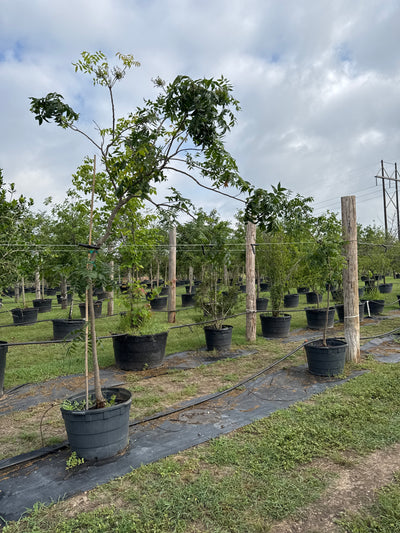


Anacacho Orchid Tree


Anacacho Orchid Tree
Location on Farm:
🌱 Planting Installation
The Anacacho Orchid Tree is named for its delicate, orchid-like flowers that bloom in spring, typically in April or May. These fragrant flowers are white with yellow throats and have a delicate, papery texture, resembling orchids hence the name. The tree produces compound leaves with two lobes, giving them a unique butterfly-like appearance. The foliage is typically bright green and provides an attractive backdrop to the flowers. After flowering, the tree may produce slender seed pods that contain small, bean-like seeds.The tree's compact size makes it well-suited for small gardens, urban landscapes, or as a focal point in mixed borders.
| Scientific Name | Bauhinia lunarioides (formerly Bauhinia congesta) |
|
Foliage: Deciduous to Semi-Evergreen |
Leaves: Each leaf is deeply cleft or divided into two rounded lobes, joined at the base. This gives them a "cloven" appearance, resembling a cloven hoof or a pair of butterfly wings. The leaves are quite small, usually only 0.5 to 1 inch long. They are thin, smooth, and have a light green to grayish-green color. The tree is typically semi-evergreen, meaning it may stay green in mild winters but will drop its leaves in colder regions. Flowers: Orchid-like in structure, with five delicate, spindly petals. Most commonly they are white, though a pale pink variety also exists. They emit a very light, sweet, and pleasant fragrance that is most noticeable in the early morning or late evening. The heaviest bloom occurs from March to May, but the tree is known to "re-bloom" sporadically throughout the summer and fall following significant rainfall. Seeds & Pods: After the flowers fade, the tree produces seed pods. The pods are flat, leathery, and roughly 1.5 to 3 inches long. They start out green and turn a dark, woody brown as they dry. Inside each pod are several small, flat, circular seeds. When fully mature and dry, the pods can twist and "snap" open (dehisce), sometimes audibly, to eject the seeds onto the ground. Bark: On young trees, the bark is smooth and light gray. As the tree matures, it becomes slightly more textured and may develop very shallow fissures or a finely shredded appearance. It generally maintains a silvery-gray to light brown hue. |
| Lifespan: Perennial | It is generally considered a moderately lived small tree or large shrub. In a garden or landscape setting, you can typically expect a lifespan of 25 to 40 years. |
| Mature Height | 6-12 feet; The tree naturally grows as a multi-trunked large shrub or small tree, with slender, graceful branches that give it an open, "see-through" canopy |
| Mature Width (Spread) | 6-12 feet |
| Growth Rate | Fast (once established) |
| USDA Zone | Zone 8-11 (Hardy to approx. 15 degrees F) |
PLANT CARE & CHARACTERISTICS
Light Requirements: Full Sun to Partial Shade. It produces the most blooms in full sun but thrives as an under-story tree in filtered light. In extremely hot climates, it appreciates protection from the harsh afternoon western sun.
Water Requirements: Low. It is a desert-native plant that prefers to dry out between waterings. It requires regular water during its first year to establish roots, but after that, it is very low-maintenance. It may benefit from occasional watering during prolonged dry spells, particularly in hot summer months.
Drought Resistance: High. It is extremely drought-tolerant and heat-hardy, making it perfect for xeriscape or water-wise landscapes.
Soil Type: Well-Drained. It specifically loves rocky, limestone-based, loamy/sandy, or alkaline soils. It will not tolerate heavy clay or standing water, which can cause root rot. Amending the soil with organic matter such as compost or aged manure before planting can improve soil fertility and drainage, promoting healthy growth and flowering.
-
Chlorosis (Iron Deficiency): While it loves alkaline soil, if the soil is extremely high in pH or lacks organic matter, the leaves may turn yellow while the veins stay green.
- Management: This isn't a disease but a nutrient issue. Applying chelated iron or sulfur to slightly lower the pH in the root zone usually fixes the color.
Deer Resistance: Moderate to High. It is generally ignored by deer. However, because it is a small tree with smooth, silvery bark, young specimens should be protected with a cage to prevent "buck rub" (antler damage) during the fall.
PEST/DISEASE RESISTANCE
1. Root Rot (Cotton Root Rot): This is the primary threat to the Anacacho Orchid Tree. It is highly susceptible to soil-borne fungi if the ground remains saturated.
- Symptoms: Sudden wilting and browning of leaves, often staying attached to the tree.
- Prevention: Drainage is mandatory. It should be planted in rocky, sandy, or well-draining limestone soil. Avoid low-lying areas where water collects after rain.
2. Aphids and Whiteflies: You might occasionally see these on the underside of the unique "cloven" leaves (which look like small butterfly wings). They suck sap and can cause minor leaf curling.
- Management: Usually controlled by natural predators like ladybugs. A strong blast of water or insecticidal soap is typically sufficient.
3. Leaf Miners: Occasionally, tiny larvae may tunnel through the leaves, creating silvery "trails." This is mostly cosmetic and does not harm the overall health of the tree.
POLLINATION
The Anacacho Orchid Tree is self-fertile, meaning a single tree can produce seeds on its own without needing another tree nearby. However, it still relies on external pollinators to move pollen from the anthers to the stigma within its delicate, fragrant flowers.
1. Primary Pollinator: This tree is considered a "pollinator powerhouse" because its nectar-rich flowers attract a wide variety of species.
-
Butterflies: The unique shape of the flower provides an excellent landing platform. It is a particular favorite for the Two-barred Flasher and various swallowtail species.
- Beyond providing nectar, the Anacacho Orchid Tree serves an ecological role for the Pale-edged Sulphur butterfly, as it often acts as a larval host plant (where the butterflies lay their eggs and the caterpillars feed on the leaves).
- Bees: Native bees and honeybees are attracted to the sweet fragrance and high nectar content during the daylight hours.
- Moths: Because the flowers are often pale white and emit a stronger fragrance at dusk and nighttime, they are a primary food source for Sphinx moths (also known as hummingbird moths).
- Hummingbirds: While butterflies and bees are more common, hummingbirds are frequently spotted visiting the blooms for nectar.
2. Seed Production & Propagation: Once pollination is successful, the tree produces flat, leathery seed pods.
- The Pods: They are roughly 2–3 inches long and turn from green to a dark, woody brown as they mature.
- The Seeds: The seeds of the Anacacho Orchid Tree are highly viable.
- Natural Spreading: When the pods dry out, they eventually "shatter" or pop open to drop the seeds. While it is not considered invasive, you may find a few "volunteer" seedlings near the base of the mother tree.
PRUNING
1. Structural Training (Single vs. Multi-Trunk): By nature, this tree wants to be a large, bushy shrub.
- Most growers prefer to prune it into a small multi-trunked tree. To do this, select 3 to 5 of the strongest main stems and remove all other small "suckers" emerging from the ground.
- The "Standard": If you want a single-trunk "lollipop" look, you will need to be diligent about removing new growth from the base for the first few years, as it will constantly try to return to its shrubby roots.
2. "Lifting" the Canopy: Since this tree only reaches about 8–12 feet, it can easily block pathways or views if the branches droop.
- The Technique: Gradually remove the lowest branches over several years. This "lifts" the canopy, allowing you to plant smaller perennials underneath and showing off the attractive gray bark.
3. Thinning for Airflow: The Anacacho Orchid Tree has very thin, delicate branches. If the interior becomes too crowded with small, "twiggy" growth it can obscure the unique butterfly-shaped leaves and reduces the visibility of the flowers.
- Action: Reach into the center of the tree and remove the tiny, weak crossing branches to "open up" the interior.
PRUNING SUMMARY
| Goal | Method | Best Timing |
| Shape Training | Lifting: Removing lower lateral branches to expose the silvery trunks. | Late Winter |
| Bloom Promotion | Deadheading: Removing spent seed pods to encourage more flowers. | After Spring Bloom |
| Health | Thinning: Removing "dead, damaged, or diseased" wood (The 3 D's). | Anytime |
| Size Management | Reduction: Lightly heading back long, leggy branches. | Early Summer |