


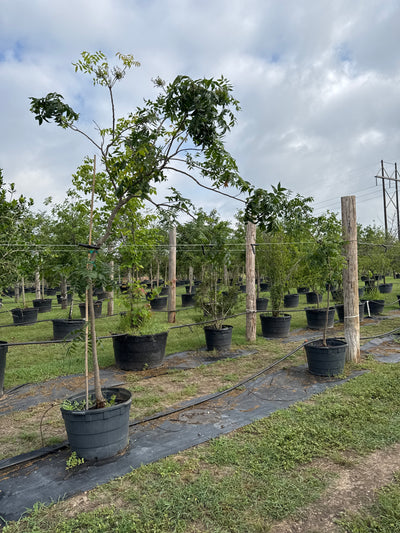


Apple Red Delicious


Apple Red Delicious
Location on Farm:
🌱 Planting Installation
The Red Delicious Apple is perhaps the most iconic-looking apple in history, known for its deep crimson color and distinctive "five-pointed" bottom. While it was the dominant commercial apple for decades, it remains a popular choice for home orchards in specific climates. The Red Delicious Apple tree produces medium to large red apples that are tender, crisp, and juicy with a sweet, mild flavor.
| Scientific Name | Malus domestica 'Red Delicious' |
|
Foliage: Deciduous |
Leaves: Broadly oval with pointed tips and finely serrated edges. They are a deep, glossy forest green on top and a paler, duller green underneath. Flowers: Classic apple blossoms: five petals, starting as dark pink buds that open into snowy white or very pale blush-pink flowers. Fruit: Medium to large with a tall, conical shape. The most defining feature is the five distinct "bumps" or lobes on the bottom. The skin is thick and deep red (sometimes striped), and the flesh is creamy white. Seeds: Small, smooth, and teardrop-shaped; they turn a dark, chocolate brown when the fruit is fully ripe. Bark: The trunk is typically grey-brown. As the tree ages, the bark becomes thick and develops a "scaly" or "platy" texture, often peeling in small, rectangular flakes. |
| Lifespan: Perennial |
Dwarf: 15 to 25 years Semi-Dwarf: 25 to 40 years Standard (Full Size): 40 to 60+ years |
| Mature Height |
Dwarf: 8 to 10 feet Semi-Dwarf: 12 to 15 feet Standard (Full Size): 20 to 25 feet |
| Mature Width (Spread) | Generally equal to the height (8-25 feet depending on rootstock); Forming a sturdy, upright-oval canopy. |
| Growth Rate | Moderate |
| USDA Zone/Chill Hours | Zone 4-8; Requires 600-900 chill hours (below 45°F); the Red Delicious needs a high number of chill hours and will likely fail to fruit in tropical or desert-fringe environments. |
PLANT CARE & CHARACTERISTICS
Light Requirements: Full Sun; (8+ hours is ideal for deep red pigmentation).
Water Requirements: Moderate; requires deep watering during dry spells, especially while the fruit is sizing up in mid-summer.
Drought Resistance: Low. Unlike the heat-hardy 'Ein Shemer', the Red Delicious does not tolerate long periods of drought. It requires consistent moisture, particularly in well-drained, loamy soil. If the soil dries out too much during the summer, the fruit can become small, bitter, or drop prematurely.
Soil Type: Well-drained, acidic, moist, fertile soil. It is particularly sensitive to "wet feet' and can develop root issues in heavy clay that doesn't drain.
Deer Resistance: Low. Deer are highly attracted to the sweet fruit and tender foliage of the Red Delicious. Protecting the trunk with guards and using fencing is essential if you have local wildlife.
Pest/Disease Resistance: It is historically susceptible to Apple Scab and powdery mildew. However, it does have a decent reputation for resisting Fire Blight and Cedar Apple Rust compared to other heirloom varieties. It is a magnet for Codling Moths (the "worm in the apple"), aphids, and mites. Regular monitoring or a preventative spray program is often necessary for high-quality fruit.
- A Note on Fire Blight: Red Delicious has some resistance, but always dip your pruners in a 10% bleach solution or 70% isopropyl alcohol between cuts if you suspect any disease. This prevents you from spreading infection throughout your orchard.
Pollination: Self sterile, not self-fertile. Meaning it is physically incapable of producing a crop without a partner tree of a different variety nearby. Ideal partners are 'Gala', 'Fuji', 'Granny Smith', ' Yellow Golden Delicious', 'Honeycrisp', and 'Callaway Crabapple'.
Harvest: Ripens typically mid to late September to mid October. Bears fruit in 6-10 years.
HARVEST TIMELINE
| Year 1 | Focus on establishing a strong central leader. Remove any fruit that sets. |
| Years 3-5 | First significant harvest. You can expect a few dozen apples as the tree structure matures. |
| Years 6-8 | The tree reaches full commercial maturity. A standard-sized tree at this stage can produce 10-20 bushels (400-800+ lbs) of fruit annually if properly pollinated. |
How to Tell if Your Red Delicious Apple Tree is Ready to Harvest
1. The "Ground Color" Test: Look at the part of the apple not exposed to direct sun (the "background"). It should shift from a hard green to a creamy yellow.
2. The Stem Snap: Use the "eye-to-sky" method. Cradle the apple and twist it upward. If it’s ready, the stem will snap cleanly away from the spur. If you have to pull hard, it needs more time.
3. Seed Inspection: Slice one open; the seeds should be a solid dark brown. If they are still white or tan, the flavor will be starchy rather than sweet.
4. The Taste Test: A ripe Red Delicious should be mild and sweet. If it is still astringent or "woody," leave the rest on the tree for another week.
YIELD
| Tree Size | Annual Yield (Bushels) | Annual Yield (Pounds) | Approx. Number of Apples |
| Dwarf | 1–4 bushels | 40–160 lbs | 125–500 |
| Semi-Dwarf | 5–10 bushels | 200–420 lbs | 625–1,250 |
| Standard | 10–20+ bushels | 420–840+ lbs | 1,250–2,500+ |
Note: A standard bushel is approximately 42 lbs. Red Delicious apples are often quite large, so you might find fewer individual fruits per bushel than with smaller varieties.
STORAGE/SHELF LIFE
Expect a shelf life of 3-6 months under ideal cold storage conditions. In a standard home refrigerator, expect 2 months of peak quality. For storage, isolate the Red Delicious apples because other vegetables that produce ethylene gas (such as carrots and broccoli) can spoil and turn the apples bitter. Aim to keep the temperature of the fridge between 32-35°F.
| STORAGE METHOD | SHELF LIFE | NOTES |
| Countertop (Room Temp) | 3–5 days | Becomes mealy and soft very quickly if left out. |
| Refrigerator (Crisper Drawer) | 3–5 months | Maintains its texture best at temperatures near 33°F. |
| Root Cellar / Cold Storage | 2–4 months | Requires high humidity (90%) and consistent cold. |
Critical Storage Tips
1. The "Mealy" Factor: Red Delicious is highly prone to becoming "mealy" or powdery. This happens when the cement-like pectin holding the cells together breaks down. While the apple stays safe to eat, the texture becomes dry and soft. Keeping them constantly refrigerated is the only way to slow this process.
2. Don't Wash Until Ready: The natural "bloom" (that slightly waxy, dusty coating on the skin) is a biological shield against bacteria and moisture loss. Washing it off early shortens the shelf life.
3. Handle Like Eggs: Even a small bruise breaks the internal cell walls. This releases enzymes that lead to rapid browning and decay. Always "place" apples into storage; never drop them.
4. Large vs. Small: Generally, smaller apples of the same variety tend to stay crisp longer than the oversized "jumbo" ones. Eat the largest apples first!
Best Uses After Long Storage
If your Red Delicious apples have spent a few months in the fridge and the texture has softened:
- Juicing: They provide a very sweet base for juice blends.
- Fruit Butter: Because they are naturally sweet and break down easily, they make excellent apple butter.
- Dried Apple Rings: The thick skin holds up well during the dehydration process.
PRUNING
The Red Delicious is a "spur-bearing" tree. This means it produces most of its fruit on short, slow-growing woody twigs called spurs that can stay productive for up to 10 years. If you accidentally prune off these spurs, you prune away your harvest.
1. Central Leader Shaping: The Red Delicious naturally wants to grow in an upright, narrow "V" shape. Your goal is to force it into a Christmas tree shape (wider at the bottom, narrower at the top). This ensures that the bottom branches aren't shaded out, which is the #1 cause of poor fruit color in this variety.
- The Main Leader: Maintain one strong central trunk.
- Branch Spacing: Ensure there is at least 18–24 inches of vertical space between your "scaffold" (main) branches to allow light to penetrate the interior.
2. Identifying and Saving Fruiting Spurs: Before you start cutting, look for the spurs. These are small, rough, knobby twigs that grow off the main branches.
- DO NOT prune these off unless they are dead.
- DO prune "water sprouts"—the thin, perfectly straight whips that shoot straight up toward the sky. They suck energy from the tree and will never produce fruit.
3. Timing the Cuts
- Primary Pruning (Winter): Late winter (January–February) while the tree is dormant. This is when you do your heavy lifting: removing large branches, thinning the canopy, and setting the height.
- Late Summer Pruning: Only if the tree is becoming too dense. Removing some of the leafy current-year growth in August can help the fruit get the sunlight it needs to turn that deep "Red Delicious" crimson.
4. The "Thinning" Technique: Red Delicious trees are notorious for "over-fruiting," which leads to small apples and broken limbs.
- Wood Pruning: If a branch is crowded with too many spurs, remove the oldest, weakest-looking spurs to give the remaining ones more room.
- Branch Angles: Red Delicious often grows branches at very tight, narrow angles. Use branch spreaders (small notched sticks) to push young branches out to a 60° angle. This strengthens the limb and encourages fruit production.
PRUNING SUMMARY
| Action | Purpose |
| Remove Suckers | Clear out growth at the base of the tree to prevent energy drain. |
| Clear the "3 Ds" | Remove Dead, Damaged, or Diseased wood immediately. |
| Thin the Top | Keep the top of the tree narrow so it doesn't "umbrella" (shade) the bottom. |
| Shorten Long Limbs | If a branch is getting too long and "bendy," cut it back to a side-growing bud to stiffen it up. |