


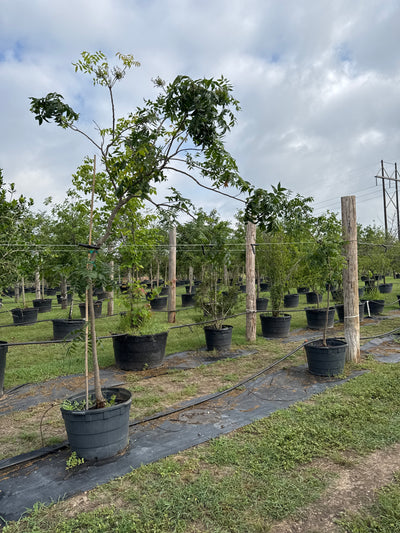


Persimmon American Common

Persimmon American Common
Location on Farm:
🌱 Planting Installation
The American Common Persimmon is a tough, cold-hardy deciduous tree native to the eastern and central regions of the United States. Belonging to the ebony family, it is deeply celebrated both as a resilient native forest tree and a valuable addition to multi-tiered edible home orchards. The tree features glossy, dark green oval leaves that transform into vibrant displays of yellow, orange, and purple in late autumn. In early summer, it blooms with small, cream-colored, bell-shaped flowers hidden beneath the canopy. The tree is typically slender, upright, and reaches 35 to 60 feet tall with a rounded or slightly weeping canopy. One of its most distinctive features is its mature bark, which is thick, dark gray-to-black, and broken into deeply furrowed, square blocks that resemble a rugged alligator skin pattern. The persimmons it bears are small, round fruits (1 to 2 inches in diameter) that mature to a pale orange, purplish-orange, or dusky blue-gray. Unlike Asian persimmons, the American common persimmon is intensely astringent (mouth-puckeringly bitter) due to high tannins until it becomes completely soft, squishy, wrinkled, and falls to the ground, revealing an incredibly rich, honey-sweet, custard-like flesh. Overall, the American Common Persimmon is extremely resilient, long-lived, adapted to USDA Zones 4 through 9, and thrives in poor, sandy, or heavy clay soils where other fruit trees struggle.
| Scientific Name | Diospyros virginiana |
| Foliage: Deciduous |
Leaves: Deciduous, alternate, simple, and oval-to-elliptic shaped, measuring 4 to 6 inches long. The leaves feature a glossy, rich dark green upper surface and a pale underside. In the autumn, they put on a spectacular show, turning vibrant shades of clear yellow, orange, and occasionally deep purple. Flowers: Small, fragrant, inconspicuous, and bell-shaped with cream-to-pale-yellow waxy petals. They bloom in late spring (May to June) after the threat of frost has passed. The species is primarily dioecious, meaning individual trees are either strictly male (flowers grow in small clusters) or strictly female (flowers grow solitary). Fruit: Small, round, glaucous berries measuring 1 to 2 inches in diameter. They turn from a dusty green to a rich, glowing pale orange or purple-orange when ripe in late autumn. The fruit is intensely astringent (mouth-puckering) until it is completely soft, wrinkled, and mushy-ripe—at which point it becomes incredibly sweet and custard-like. Seeds: Flat, smooth, dark brown, and highly compressed woody seeds (typically 1 to 8 seeds per fruit). Seedless fruits can occasionally occur on female trees if no male pollinator is nearby, though they will be smaller. Bark: One of the most striking ornamental features of the tree. Mature bark is dark gray to near-black, thick, and broken into deeply furrowed, distinctive square or rectangular blocks resembling a rugged alligator skin pattern or a charcoal checkerboard. |
| Life Span: Perennial | Wild and well-established cultivated trees routinely live for 60 to 150+ years. |
| Mature Height | 35 to 60 feet tall in standard landscape settings (though it can reach up to 80+ feet in its native deep-soil bottomland forest habitats). |
| Mature Width (Spread) | 25 to 35 feet wide, naturally developing a slender, erect, or gracefully rounded canopy with slightly drooping branches. |
| Growth Rate | Slow to Moderate. It focuses heavily on developing a massive, deep taproot during its first few years before pushing rapid top-growth (typically 1 to 2 feet per year in youth). |
| USDA Zone | Zones 4 through 9. This is an incredibly cold-hardy fruit tree, capable of fully withstanding winter drops down to -25°F without wood damage. |
| Chill Hours | 100 to 400 chill hours (hours spent between 32°F and 45°F). Despite its extreme cold hardiness, it has a low chilling requirement to break dormancy. However, it naturally leafs out and blooms very late in the spring, protecting its flowers from late frosts. |
PLANT CARE & CHARACTERISTICS
Light Requirements: Full Sun to Partial Shade. It produces the best canopy structure, strongest wood, and maximum fruit yield when grown in full sun (at least 6 to 8 hours of direct daily sunlight). However, as a native woodland edge species, it is remarkably shade-tolerant and can grow successfully in partial shade, though fruit production will decrease.
Water Requirements: Low to Medium. Once established, it requires minimal supplemental watering and can rely almost entirely on natural rainfall. During its first 2 to 3 years, it needs regular, deep watering to support the development of its massive, characteristic taproot.
Drought Resistance: Extremely High. It is highly drought-tolerant once its deep taproot system is anchored into the ground. It will easily survive severe mid-summer droughts that would kill or defoliate other fruit trees, though extreme drought may cause it to drop some of its developing fruit prematurely.
Soil Type: Incredibly Adaptable. It grows across a massive range of soils, thriving in everything from rich, moist bottomland loams to poor, rocky, sandy, or heavily eroded clay soils. It tolerates a wide pH range (5.5 to 7.8). While it prefers moist, well-drained conditions, it is one of the few fruit trees that can tolerate heavy, poorly drained clay or brief periods of flooding.
Deer Resistance: High (for the wood/foliage) / Low (for the fruit). Deer rarely browse the mature twigs, bitter leaves, or rugged alligator-skin bark. However, once the sweet, honey-like fruits ripen and fall to the ground in autumn, they become an absolute magnet for deer, raccoons, opossums, and birds.
Pest/Disease Resistance: High. Being a native species, it is exceptionally tough and virtually trouble-free compared to Asian persimmons or other stone fruits. It has no serious insect pests that threaten its life, though webworms may occasionally form unsightly nests in the foliage during late summer. Its main disease vulnerability is Persimmon Wilt (Cephalosporium diospyri), a fungal disease primarily found in the southern states that can enter via open wood wounds.
POLLINATION
The pollination of the American Common Persimmon is one of its most important characteristics because, unlike most modern fruit trees, you almost always need two different trees to get a harvest. Here is exactly how its unique native pollination dynamics work:
1. Pollination Requirement: Dioecious (Separate Sexes). In the wild, American persimmons are strictly male or female. To get fruit, you must plant at least one male tree to provide pollen and one female tree to bear the fruit. One male tree can successfully pollinate up to 6 to 8 nearby female trees. For standard dioecious trees, ensure your male and female trees are planted within 50 to 100 feet of each other.
2. Primary Pollinators: Honeybees, Native Bees (Bumblebees, Sweat Bees), and Wind. The flowers produce a rich, sweet nectar that makes them highly attractive to insects, even though the blossoms are small and hidden under the green foliage.
3. How to Tell the Flowers Apart: You can identify the sex of your trees in late spring by looking closely at the blossoms.
- Male Flowers: Small, vase-shaped, and grow in tight clusters of 2 to 3. They have prominent, pollen-covered stamens inside.
- Female Flowers: Larger, solitary (they grow completely alone on the twig), and feature a distinct, swollen green ovary at the base of the petals that will eventually become the fruit.
4. The Exception (Seedless Parthenocarpy): Female American persimmons can occasionally produce fruit without a male pollinator nearby through a process called parthenocarpy. However, these unpollinated fruits will be completely seedless, usually significantly smaller, and are much more prone to dropping off the tree before they fully ripen.
HARVEST
1. Harvest Window: September through November (and into December), depending entirely on your climate zone and the specific tree. It is a true late-autumn-to-early-winter harvest
2. Years to First Harvest: 3 to 5 years for a grafted cultivar; 8 to 10+ years if grown from a wild seed.
3. The Best Harvesting Method: The Ground Harvest. You rarely pick American persimmons off the branches. When they are truly ripe and the tannins have completely broken down into sugars, they lose their grip on the twig and naturally drop to the ground. The absolute best way to harvest them is to gently shake the tree or simply gather the freshly fallen fruits daily from a clean tarp spread beneath the canopy.
How to Identify a Ripe, Sweet Fruit
Before you take a bite, use these three physical checkpoints to ensure the tannins have completely vanished:
1. The Calyx Test: Look at the green, hat-like leaf structure (calyx) at the top of the fruit. On an underripe, bitter persimmon, the calyx is glued tightly to the skin. On a fully ripe, sweet fruit, the calyx will detach effortlessly with a gentle tug, or it may have already fallen off.
2. The Color Shift: The fruit will transition from a firm, chalky, pale orange to a deep, dark orange with a dull, slightly dull purple or bluish waxy bloom coating the skin.
3. The Texture: They should be extremely soft, squishy, slightly wrinkled, and translucent-looking. It must feel like a water balloon or a soft jelly doughnut. If there is any firmness left in the flesh, leave it alone.
STORAGE/SHELF LIFE
1. Short Counter Life: Because they are harvested at an incredibly soft, mushy stage, ripe whole American persimmons have a very short shelf life—usually only 2 to 3 days on a countertop before they begin to ferment.
2. The Ripening Box: If you must harvest them off the tree early (to beat the local wildlife), pick fruits that are fully orange but still firm. Place them in a paper bag or a sealed box with a ripe banana or apple. The natural ethylene gas will accelerate the softening process and help clear the astringency.
3. Processing for the Freezer: Because the whole fruits don't store well, most growers immediately process the harvest. Pulse the soft fruits through a food mill or colander to separate the skin and seeds from the rich, orange pulp. This smooth, honey-sweet pulp can be frozen in zip-top bags for up to a year and used for traditional persimmon puddings, breads, and cookies.
PRUNING
Pruning the American Common Persimmon requires a gentle touch and a long-term view. Unlike peach or apple trees that demand aggressive annual hacking to produce good fruit, the native American persimmon is a low-maintenance, slow-growing hardwood. It has a high natural resistance to pests and diseases, meaning it does its best work when left largely to its own devices. Because it bears fruit on the current season’s new growth (sprouting from buds formed the previous year), over-pruning will systematically eliminate your upcoming harvest.
1. Major Canopy Pruning: Perform this in late winter (January to February) while the tree is fully dormant and bare. This gives you a clear view of the branch structure and prevents sap-bleeding.
2. Suckering & Corrective Cuts: Late summer is fine for minor touch-ups, but avoid major cuts after spring leaf-out, as open wounds can invite Persimmon Wilt spores.
3. Structural Goal (The Modified Central Leader): Because American persimmons can grow into towering, 50-foot trees with brittle wood, training them early to a Modified Central Leader system is vital. This ensures a strong, central backbone that can handle heavy crop loads without splitting.
- Years 1 to 3: Let a strong central trunk grow straight up. Select 4 to 5 main lateral "scaffold" branches that spiral around the trunk, spaced about 12 inches apart vertically. Ensure these branches have wide, strong angles (roughly 45 to 60 degrees) where they meet the trunk.
- Year 4+ (The Modification): Once the tree reaches your desired picking height (usually 12 to 15 feet for a home orchard), cut the main vertical leader back to a strong outward-growing lateral branch. This caps the vertical height and opens the top canopy to the sun.
4. Critical Rule: Avoid "Heading" Cuts: Never drive around the perimeter of a persimmon tree and blindly give it a "haircut" by snipping off all the branch tips. Because the flowers and fruit develop on new shoots pushing out from the tips of last year's wood, heading back the tips will completely remove the fruiting zone. Always use thinning cuts instead—which means removing an entire branch right back to its point of origin on a larger limb. This opens up air and sunlight without destroying your upcoming crop.
The Minimalist Pruning Checklist
Once your tree structure is established, your annual winter pass should follow a strict "less is more" philosophy:
1. Remove the "Three D's: Always start by cutting out any branches that are Dead, Damaged, or Diseased. American persimmon twigs are relatively brittle and can snap under heavy autumn fruit loads or winter ice; clean these breaks back to a healthy branch collar.
2. Control the Base (Suckers): American persimmons have a powerful, deep taproot and love to throw up aggressive root suckers at the base of the tree—especially if the tree is grafted. Cut these off flush with the ground or below the soil line every winter to keep them from stealing energy from the main canopy.
3. Thin out Narrow Crotch Angles: Watch for branches that are growing tightly parallel to the main trunk (narrow V-shaped crotches). As the tree grows, bark gets trapped in that tight joint, creating a structural weak point that will easily split open under the weight of a heavy autumn harvest. Remove them in favor of wider, U-shaped branch joints.
4. Skirt the Lower Canopy (For Ground Harvest): Because the best way to harvest American persimmons is to let them naturally drop to the ground onto tarps, clear away any low, weeping branches that sit under 4 to 5 feet. Elevating the "skirt" of the tree gives you clear physical access to clean up fallen fruit daily and keeps wild animals from easily reaching into the lower canopy.